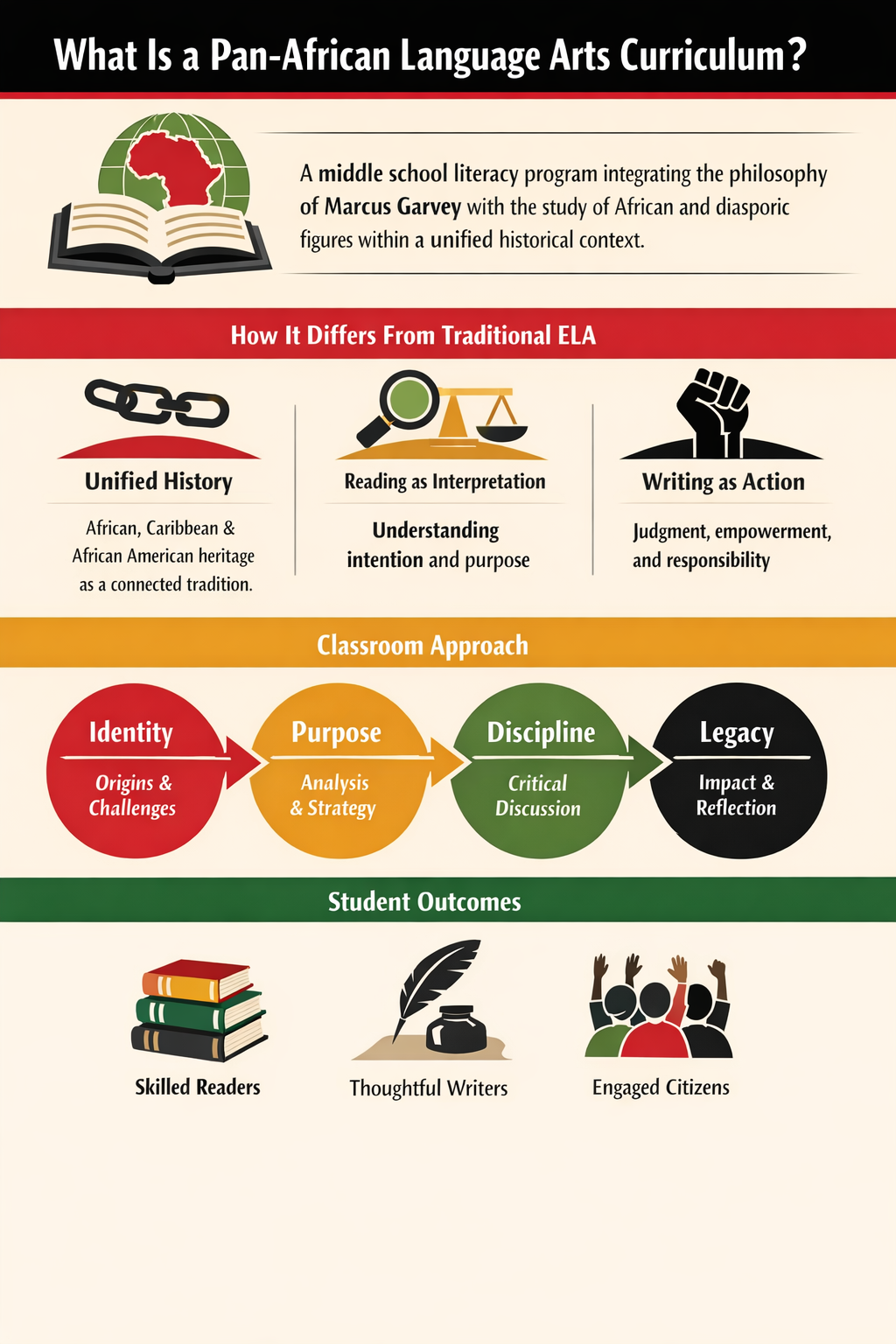
A Pan-African Language Arts curriculum is a middle school literacy approach that teaches reading, writing, and reasoning through a continuous intellectual tradition connecting African, Caribbean, and African American thinkers. Students analyze historical problems, evaluate decisions made by past figures, and write evidence-based arguments as participants in an ongoing conversation rather than observers of isolated texts.
A Pan-African Language Arts curriculum is a standards-aligned middle school literacy program that integrates the philosophy of Marcus Garvey with the biographical study of African and diasporic figures to teach rigorous reading, writing, and analytical skills within a unified historical context.
Distinctions from Traditional ELA Curricula
This model diverges from standard educational approaches by rejecting the separation of African, Caribbean, and African American histories into isolated national narratives, instead presenting them as a continuous, transnational intellectual lineage. While traditional language arts instruction often treats history as static information and literacy as a purely technical skill, this framework positions education as an entry into an ongoing “generational mission” where reading functions as the interpretation of intention and writing operates as an act of judgment. Furthermore, the scope and sequence are not organized by literary genre or disparate themes, but by a psychological progression that moves students through stages of mental clarity, purpose, discipline, and legacy to mirror the development of historical consciousness.
Classroom Practice
Instruction adheres to a consistent weekly architecture designed to guide students from basic comprehension to complex synthesis, mirroring the process of analyzing and acting upon inherited conditions. A typical week begins with the close reading of a primary source or biography to establish facts, progresses to an analysis of the historical figure’s origins and specific challenges, and culminates in an evaluation of their strategic decisions and long-term impact. Daily lessons follow a standardized sequence that includes text engagement, vocabulary analysis, and Socratic discussion, ensuring that students constantly practice reasoning with evidence. Within this structure, differentiation is provided through scaffolding tools like sentence frames, allowing students of varying ability levels to engage with the same rigorous intellectual content.
Student Learning Outcomes
Academically, students are expected to demonstrate the ability to read complex texts with confidence, construct clear thesis statements, and engage in respectful, evidence-based oral argumentation. Beyond these technical competencies, the curriculum aims to foster “intellectual ancestry,” a cognitive outcome where students recognize that they have inherited a set of tools and unfinished tasks from previous generations. By the end of the program, a successful learner possesses a specific “orientation,” understanding that they are not mere spectators of history but active participants responsible for carrying forward the work of the figures they have studied.
Educational Purpose in Society
The broader social function of this curriculum is to repair the historical fragmentation caused by educational systems that rendered the connections between Black thought and resistance invisible to students. By centering concepts of “mental emancipation” and “reorientation,” the model seeks to help students distinguish between inherited assumptions and examined truths, thereby allowing them to construct their own intellectual frameworks. Ultimately, the curriculum is designed to produce citizens who understand that individual discipline must lead to collective organization, ensuring that the institutions necessary for community life are built and sustained across generations.
Yoast FAQ
What is a Pan-African Language Arts curriculum?
A Pan-African Language Arts curriculum is a middle school literacy approach that teaches reading, writing, and reasoning through a continuous intellectual tradition connecting African, Caribbean, and African American thinkers. Students analyze historical problems, evaluate decisions made by past figures, and write evidence-based arguments as participants in an ongoing conversation rather than observers of isolated texts.
Save/update the page.