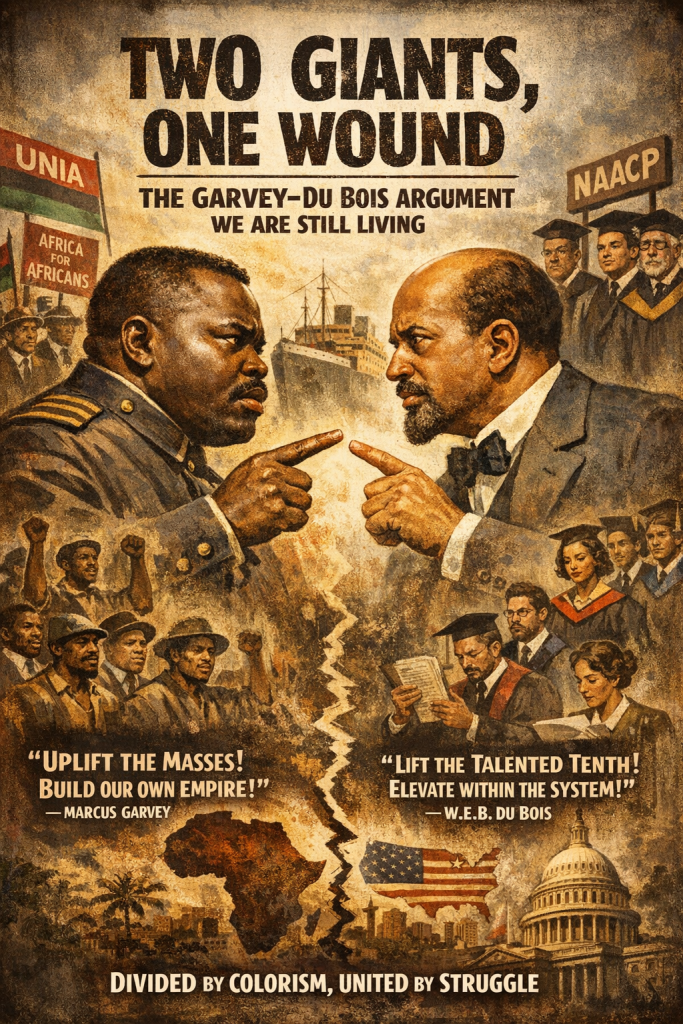
Garvey walked into the NAACP office in 1916 to meet Du Bois. What he found stopped him cold.
“The whole staff was either white or very near white. There was no representation of the race there that anyone could recognize.”
— Marcus Garvey, The Philosophy and Opinions of Marcus Garvey
That moment crystallized a rivalry that would define Black political thought for the next century. Du Bois believed the talented tenth — the educated elite — would lift the race from within the existing system. Garvey believed the system was the problem, and that building a movement on an educated light-skinned vanguard was not liberation. It was color caste wearing the language of progress.
Du Bois described Garvey in print as a “little, fat, black man; ugly.” Garvey’s response cut to the bone:
“What does DuBois mean by ugly? The standard of beauty within a race is not arrived at by comparison with another race. Anything that is black, to him, is ugly, is hideous, is monstrous.”
— Marcus Garvey, The Philosophy and Opinions of Marcus Garvey
That single exchange contains the entire colorism debate. Du Bois reached for that word instinctively. Garvey made him own what it revealed.
Garvey’s counter was to build for the people Du Bois had quietly written off. Four million UNIA members across forty countries. Working people contributing small amounts to a collective vision. The Black Star Line was not built by Harvard graduates.
“DuBois cares not for an Empire for Negroes, but contents himself with being a secondary part of white civilization.”
— Marcus Garvey, The Philosophy and Opinions of Marcus Garvey
Du Bois eventually moved closer to Garvey than either man would have admitted. He died in Ghana in 1963, on African soil, one day before the March on Washington. The man who opposed Pan-Africanism chose Africa as his final address.
The argument was never resolved. It only changed clothes. Colorism in Black professional spaces. Representation versus reparations. Working within the system versus building outside it. Every one of those debates has Garvey and Du Bois somewhere in its bloodline.
“Let us not divide ourselves into castes, but let us all work together for the common good.”
— Marcus Garvey, The Philosophy and Opinions of Marcus Garvey
Start with The Philosophy and Opinions of Marcus Garvey and The Souls of Black Folk. Read them back-to- back. The argument between those two books is still the argument we are having today.