Tag: Marcus Garvey Education

  • The Garvey Blueprint at the Marcus Garvey Education Academy

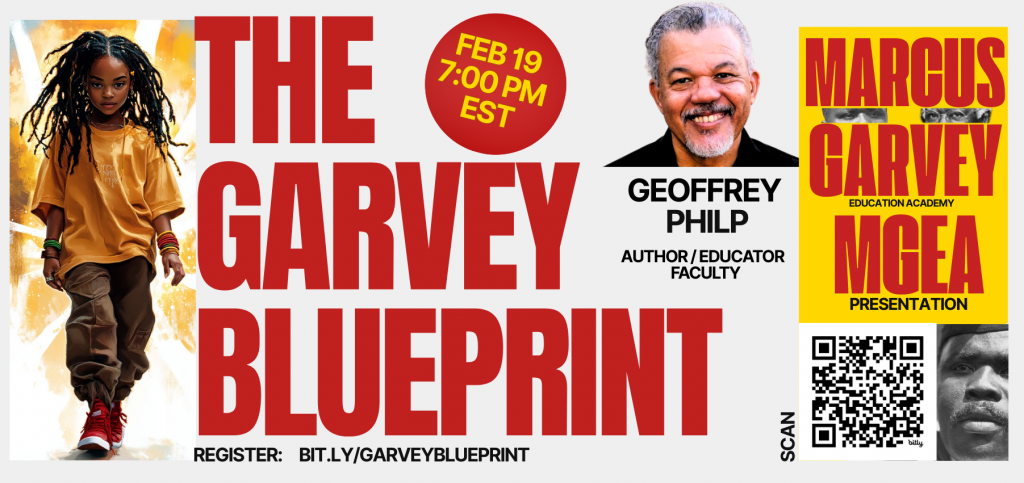
    Geoffrey Philp presents The Garvey Blueprint at the Marcus Garvey Education Academy MGEA February 19 2026 7 PM EST event flyer
    Geoffrey Philp presents The Garvey Blueprint at the Marcus Garvey Education Academy (MGEA), February 19, 2026, 7:00 PM EST. Register at bit.ly/garveyblueprint.

    I grew up in Kingston, Jamaica. Marcus Garvey was everywhere and nowhere. His name was on buildings. His face was on the currency. But his ideas were absent from the classroom.

    That absence shaped everything I have done since.

    For thirty years, I studied Garvey’s writings. I spent six years teaching middle school English, and then I taught college for twenty-seven years. And across all that time, one question kept returning: Why do our children learn about Garvey as a portrait on a wall, never as a thinker whose methods they can use?

    The Garvey Blueprint is my answer.

    On Thursday, February 19, at 7:00 PM EST, I will be presenting The Garvey Blueprint at the Marcus Garvey Education Academy. The presentation is open to educators, parents, school leaders, and anyone who believes that Black children deserve a curriculum built from inside their own intellectual tradition.

    The Garvey Blueprint: A Conversation with the Marcus Garvey Education Academy

    February 19, 2026 | 7:00 PM EST

    Register: bit.ly/garveyblueprint

    Direct Zoom Link: https://us06web.zoom.us/j/4045329958

    What Is The Garvey Blueprint?

    The Garvey Blueprint is a three-year Pan-African literacy curriculum for grades 6 through 8. It uses English Language Arts as the medium through which students encounter the intellectual, political, and cultural history of Africa and its diaspora.

    Across 39 instructional weeks per year, students study 31 historical figures per grade. Over three years, they encounter 75 unique historical figures and one fictional character. Nine staple figures return every year, studied through a different analytical lens each time. A sixth grader meets Frederick Douglass through the question of clarity. An eighth grader meets Douglass through the systems that criminalized Black literacy. The figure stays the same. The thinking transforms.

    Three pillars govern the curriculum: the Power of the Mind, the Importance of Purpose, and the Strength of Perseverance. These pillars come directly from Garvey’s educational philosophy. They are structural principles embedded in every quarter, every framing question, and every assessment.

    Why This Curriculum Exists

    Colonial education divided what belonged together. African intellectual history. Caribbean political thought. African American literary tradition. These are chapters of the same story, separated by design. The Garvey Blueprint reconnects them.

    Every instructional week begins with an original historical fiction anchor text. Students enter through story. They meet Harriet Tubman, Arturo Schomburg, Frantz Fanon, Antonio Maceo, Ella Baker, and dozens more as characters in a narrative before analyzing them as strategists and system-builders. The stance toward every figure is operational: What did this person build? What did it cost? Can the method be applied?

    This is what we call Builders and Their Blueprints. Historical figures studied as architects of liberation whose methods transfer to the student’s own condition.

    What I Will Cover on February 19

    The presentation will walk through the curriculum’s architecture. How the three pillars organize instruction across quarters. How the eight developmental stages, drawn from Garvey’s own declarations, form a spine that holds together three years of learning. How the weekly rhythm moves students through four cognitive levels every single week. How the Grit Guardrail Framework ensures that when we study perseverance, we study it alongside the systems that made perseverance necessary.

    I will also address the question that every parent and educator asks first: How does this prepare students for standardized assessments? The answer is direct. The Garvey Blueprint aligns with state ELA standards. Reading, writing, speaking, and listening are embedded in every week. Students write claims with evidence. They build analytical essays. They engage in Socratic discussion. By eighth grade, they defend a capstone portfolio tracing their intellectual development across three years.

    The curriculum does not choose between cultural grounding and academic rigor. It treats them as the same project.

    If you are an educator looking for a curriculum that teaches Black history as a year-round intellectual framework, this presentation is for you.

    Who Should Attend

    If you are a parent searching for something that meets your child where they are and takes them somewhere they have never been, this is for you.

    If you are a school leader considering what a Pan-African ELA curriculum looks like when it is standards-aligned, assessment-ready, and built to last three years, this conversation is where you start.

    Join the Conversation

    Thursday, February 19, 2026

    Time: 7:00 PM EST

    Host: Marcus Garvey Education Academy (MGEA)

    Register: bit.ly/garveyblueprint

    Direct Zoom Link: https://us06web.zoom.us/j/4045329958

    Share this with anyone you think may be interested. The door is open.

    Geoffrey Philp is the founder of The Garvey Classroom LLC and creator of The Garvey Blueprint. He is the author of several books of fiction and poetry, a Silver Musgrave Medal recipient, and a Marcus Garvey Award for Excellence in Education honoree. He has spent twenty-seven years teaching at the college level and six years teaching middle school English.

    Frequently Asked Questions

    What is The Garvey Blueprint curriculum?

    The Garvey Blueprint is a three-year Pan-African literacy curriculum for grades 6 through 8. It uses original historical fiction anchor texts to teach 75 unique historical figures across three years, organized around three pillars drawn from Marcus Garvey’s educational philosophy: the Power of the Mind, the Importance of Purpose, and the Strength of Perseverance.

    Who created The Garvey Blueprint?

    Geoffrey Philp, a Jamaican-born author and educator with twenty-seven years of college teaching experience, six years as a middle school English teacher, and two decades of Marcus Garvey scholarship, created The Garvey Blueprint through The Garvey Classroom LLC.

    Is the Garvey Blueprint aligned with state standards?

    Yes. The Garvey Blueprint aligns with state ELA standards, including the New York State Next Generation English Language Arts Learning Standards. Reading, writing, speaking, and listening are embedded in every instructional week.

    What grades does The Garvey Blueprint serve?

    The curriculum serves grades 6 through 8 across a three-year developmental sequence. Each grade has its own central question and analytical lens, with nine staple figures returning each year at increasing levels of cognitive demand.

    How is The Garvey Blueprint different from other culturally responsive curricula?

    The Garvey Blueprint is story-driven, meaning every instructional week is built around an original historical fiction anchor text. It studies historical figures as strategists and system-builders whose methods are transferable, rather than as inspirational symbols. Social-emotional learning is embedded in the academic work, with no standalone SEL lessons.

    What is the Marcus Garvey Education Academy (MGEA) presentation?

    On February 19, 2026, at 7:00 PM EST, Geoffrey Philp will present The Garvey Blueprint at the Marcus Garvey Education Academy. The virtual presentation is open to educators, parents, and school leaders.

    Register at bit.ly/garveyblueprint.

  • Black History Every Month: Confidence-Building Lesson Plans from the Garvey Classroom

    Circular logo for The Garvey Classroom featuring Marcus Garvey and the phrase “Confidence is our birthright.”

    Lesson Plans for the Entire School Year

    Summer vacations are never vacations for committed educators. Sure, they may take two weeks to decompress, but many teachers, especially those in the UK, are already preparing for Black History Month, which this year focuses on the theme of “Standing Firm.” Homeschooling parents scan resources for materials that honor our legacy with dignity. Both search for lessons that will matter. Meanwhile, families wonder how to extend these conversations beyond a single month. All face the same challenge: How do we teach Black history as a living, breathing force rather than a seasonal obligation?

    I built the Garvey Classroom to answer that question. I’ve created lesson plans that focus on Garvey because it is my area of specialization. These lesson plans work effectively during Black History Month, yet they refuse to be confined to that month. Throughout the school year, during the transition weeks in March, when curricula shift elsewhere, these units continue to build the confidence our children deserve.

    The Foundation of Story

    Most educational resources mention Marcus Garvey in passing, reducing him to a name for memorization or dates for recall. Rather than engaging students meaningfully, existing lesson plans about Garvey concentrate on the lowest level of Bloom’s taxonomy: remembering dates, memorizing facts, and identifying basic information. My approach differs fundamentally. Beginning with either informational texts or stories, every Garvey Classroom lesson invites students to encounter authentic material first and then explore its deeper meaning.

    This approach transforms learning. When a lesson opens with a story rather than a textbook summary, students connect with the man behind the movement. They hear his passion, sense his urgency, and feel his hope. From this authentic foundation, they explore questions that matter: Who am I in this world? What is my purpose? How do I cultivate a free mind?

    Consider how this works in practice. Instead of reading about Garvey’s belief in Black excellence, students examine his speeches about self-determination. Rather than memorizing facts about the Universal Negro Improvement Association, they grapple with his vision of global unity and compare it to that of equally committed Pan-Africanists, such as W.E.B. Du Bois. They don’t just learn what happened. They discover what remains possible.

    Principles That Guide Every Lesson Plan

    Each resource in The Garvey Classroom operates from core principles that distinguish it from conventional materials. These principles shape every activity, every question, and every moment of learning.

    Story anchors understanding. Narrative and informational passages ground each lesson in real experience.

    Essential questions spark reflection. Rather than surface-level queries, students wrestle with profound challenges: “How do I stand firm in who I am?” “What does freedom look like in my daily life?” These questions connect historical understanding to personal growth.

    Heart and mind work together. I refuse to separate emotional development from academic achievement. The lesson plans incorporate Social-Emotional Learning (SEL) to engage students emotionally in Garvey’s story and Black history. Students need both intellectual understanding and emotional connection to thrive; therefore, every lesson integrates social-emotional learning with rigorous academic content.

    Creativity completes the circle. Students express their understanding through art, reflection, discussion, and creation. Worksheets serve as a means to learn when needed, but they never become the endpoint.

    Lesson Plans for Educators

    The lesson plans of Teachers Pay Teachers are drawn from decades of educational expertise. My six years as a middle school teacher, combined with thirty years as a professor at Miami Dade College, including thirteen years as chairperson of developmental education, taught me how to create developmentally appropriate materials that meet students where they are.

    As an English teacher, through training and practice, I have developed the ability to use stories and texts to engage students meaningfully and effectively. Twenty years of researching and writing about Marcus Garvey as an author, blogger, and activist have given me a deep understanding of his philosophy and its relevance to today’s students. My blog, Geoffrey Philp’s Blog Spot, which has been in existence for over 25 years, contains extensive posts and insights that inform these lesson plans.

    Each lesson plan reflects this foundation. Drawing on Piaget’s developmental stages, I recognize how kindergarten students learn differently from middle school students. By building effective scaffolding, my materials support student growth at every level. Through applying Bloom’s taxonomy, questions move students from basic recall to critical analysis. Years of reviewing countless syllabi at Miami Dade College and creating my own curricula revealed what makes instruction both educationally and psychologically sound.

    Yet practicality never compromises purpose. Each lesson remains student-centered, focused on reflection and expression. Historical accuracy underpins every activity, drawing on primary sources and rigorous research. Students encounter what happened so they can envision what might become possible.

    Every unit offers:

    • Substitute-ready structure: Clear directions, printable materials, easy implementation
    • Classroom-tested design: Built from six years of middle school teaching and thirty years of college-level instruction, refined through real classroom experience
    • Developmentally appropriate content: Designed with an understanding of how students learn at each grade level
    • Student-centered approach: Focused on reflection, expression, and confidence-building
    • Historical accuracy: Sourced from primary texts, decades of Garvey research, and scholarly foundations

    Your Next Steps

    The Garvey Classroom exists for educators, parents, and advocates who build rather than wait. Those who understand that our future depends on how we teach our past and how we claim our present.

    Begin by sharing these resources with your network. Download a free lesson plan and experience it in your own space. Engage students with the essential questions that spark real growth. Discuss Garvey’s ideas as living wisdom that speaks to today’s challenges.

    Most importantly, use these tools as foundations for something larger. Let them become starting points for growth, clarity, and cultural strength that extends far beyond any single month or designated celebration.

    Our children deserve an education that honors their brilliance throughout the year. The Garvey Classroom helps bring that vision to life.

    Explore the full collection: Visit The Garvey Classroom on TPT.

    Related Resources: Marcus Garvey FAQ Philosophy and Opinions of Marcus Garvey

    Coming Soon: Lesson Plans for Standing Firm During Black History Month in the UK

    In the next post, I’ll focus on the specific types of lesson plans we’re offering for Black History Month in the UK. Each one is designed to align with the theme of Standing Firm while honoring developmental needs and cultural context. From early years to secondary classrooms, these resources provide tools for confidence-building, critical thinking, and meaningful reflection.