Tag: Garvey Classroom

A hub for culturally grounded lessons, reflections, and mindset tools from The Garvey Classroom—where education and liberation walk hand in hand.

  • The Garvey Blueprint at the Marcus Garvey Education Academy

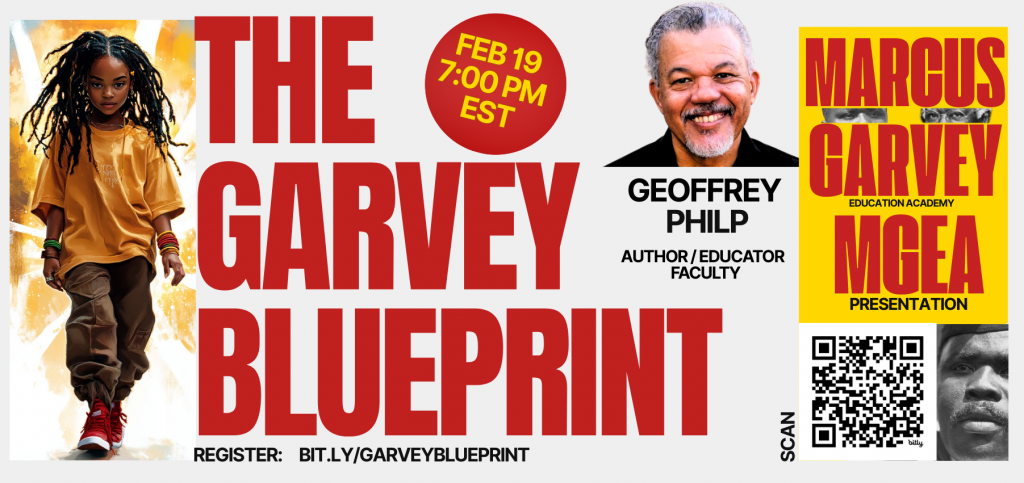
    Geoffrey Philp presents The Garvey Blueprint at the Marcus Garvey Education Academy MGEA February 19 2026 7 PM EST event flyer
    Geoffrey Philp presents The Garvey Blueprint at the Marcus Garvey Education Academy (MGEA), February 19, 2026, 7:00 PM EST. Register at bit.ly/garveyblueprint.

    I grew up in Kingston, Jamaica. Marcus Garvey was everywhere and nowhere. His name was on buildings. His face was on the currency. But his ideas were absent from the classroom.

    That absence shaped everything I have done since.

    For thirty years, I studied Garvey’s writings. I spent six years teaching middle school English, and then I taught college for twenty-seven years. And across all that time, one question kept returning: Why do our children learn about Garvey as a portrait on a wall, never as a thinker whose methods they can use?

    The Garvey Blueprint is my answer.

    On Thursday, February 19, at 7:00 PM EST, I will be presenting The Garvey Blueprint at the Marcus Garvey Education Academy. The presentation is open to educators, parents, school leaders, and anyone who believes that Black children deserve a curriculum built from inside their own intellectual tradition.

    The Garvey Blueprint: A Conversation with the Marcus Garvey Education Academy

    February 19, 2026 | 7:00 PM EST

    Register: bit.ly/garveyblueprint

    Direct Zoom Link: https://us06web.zoom.us/j/4045329958

    What Is The Garvey Blueprint?

    The Garvey Blueprint is a three-year Pan-African literacy curriculum for grades 6 through 8. It uses English Language Arts as the medium through which students encounter the intellectual, political, and cultural history of Africa and its diaspora.

    Across 39 instructional weeks per year, students study 31 historical figures per grade. Over three years, they encounter 75 unique historical figures and one fictional character. Nine staple figures return every year, studied through a different analytical lens each time. A sixth grader meets Frederick Douglass through the question of clarity. An eighth grader meets Douglass through the systems that criminalized Black literacy. The figure stays the same. The thinking transforms.

    Three pillars govern the curriculum: the Power of the Mind, the Importance of Purpose, and the Strength of Perseverance. These pillars come directly from Garvey’s educational philosophy. They are structural principles embedded in every quarter, every framing question, and every assessment.

    Why This Curriculum Exists

    Colonial education divided what belonged together. African intellectual history. Caribbean political thought. African American literary tradition. These are chapters of the same story, separated by design. The Garvey Blueprint reconnects them.

    Every instructional week begins with an original historical fiction anchor text. Students enter through story. They meet Harriet Tubman, Arturo Schomburg, Frantz Fanon, Antonio Maceo, Ella Baker, and dozens more as characters in a narrative before analyzing them as strategists and system-builders. The stance toward every figure is operational: What did this person build? What did it cost? Can the method be applied?

    This is what we call Builders and Their Blueprints. Historical figures studied as architects of liberation whose methods transfer to the student’s own condition.

    What I Will Cover on February 19

    The presentation will walk through the curriculum’s architecture. How the three pillars organize instruction across quarters. How the eight developmental stages, drawn from Garvey’s own declarations, form a spine that holds together three years of learning. How the weekly rhythm moves students through four cognitive levels every single week. How the Grit Guardrail Framework ensures that when we study perseverance, we study it alongside the systems that made perseverance necessary.

    I will also address the question that every parent and educator asks first: How does this prepare students for standardized assessments? The answer is direct. The Garvey Blueprint aligns with state ELA standards. Reading, writing, speaking, and listening are embedded in every week. Students write claims with evidence. They build analytical essays. They engage in Socratic discussion. By eighth grade, they defend a capstone portfolio tracing their intellectual development across three years.

    The curriculum does not choose between cultural grounding and academic rigor. It treats them as the same project.

    If you are an educator looking for a curriculum that teaches Black history as a year-round intellectual framework, this presentation is for you.

    Who Should Attend

    If you are a parent searching for something that meets your child where they are and takes them somewhere they have never been, this is for you.

    If you are a school leader considering what a Pan-African ELA curriculum looks like when it is standards-aligned, assessment-ready, and built to last three years, this conversation is where you start.

    Join the Conversation

    Thursday, February 19, 2026

    Time: 7:00 PM EST

    Host: Marcus Garvey Education Academy (MGEA)

    Register: bit.ly/garveyblueprint

    Direct Zoom Link: https://us06web.zoom.us/j/4045329958

    Share this with anyone you think may be interested. The door is open.

    Geoffrey Philp is the founder of The Garvey Classroom LLC and creator of The Garvey Blueprint. He is the author of several books of fiction and poetry, a Silver Musgrave Medal recipient, and a Marcus Garvey Award for Excellence in Education honoree. He has spent twenty-seven years teaching at the college level and six years teaching middle school English.

    Frequently Asked Questions

    What is The Garvey Blueprint curriculum?

    The Garvey Blueprint is a three-year Pan-African literacy curriculum for grades 6 through 8. It uses original historical fiction anchor texts to teach 75 unique historical figures across three years, organized around three pillars drawn from Marcus Garvey’s educational philosophy: the Power of the Mind, the Importance of Purpose, and the Strength of Perseverance.

    Who created The Garvey Blueprint?

    Geoffrey Philp, a Jamaican-born author and educator with twenty-seven years of college teaching experience, six years as a middle school English teacher, and two decades of Marcus Garvey scholarship, created The Garvey Blueprint through The Garvey Classroom LLC.

    Is the Garvey Blueprint aligned with state standards?

    Yes. The Garvey Blueprint aligns with state ELA standards, including the New York State Next Generation English Language Arts Learning Standards. Reading, writing, speaking, and listening are embedded in every instructional week.

    What grades does The Garvey Blueprint serve?

    The curriculum serves grades 6 through 8 across a three-year developmental sequence. Each grade has its own central question and analytical lens, with nine staple figures returning each year at increasing levels of cognitive demand.

    How is The Garvey Blueprint different from other culturally responsive curricula?

    The Garvey Blueprint is story-driven, meaning every instructional week is built around an original historical fiction anchor text. It studies historical figures as strategists and system-builders whose methods are transferable, rather than as inspirational symbols. Social-emotional learning is embedded in the academic work, with no standalone SEL lessons.

    What is the Marcus Garvey Education Academy (MGEA) presentation?

    On February 19, 2026, at 7:00 PM EST, Geoffrey Philp will present The Garvey Blueprint at the Marcus Garvey Education Academy. The virtual presentation is open to educators, parents, and school leaders.

    Register at bit.ly/garveyblueprint.
  • The Garvey Classroom Resources

    The Garvey Classroom Resources

    The Garvey Classroom was created to give our children the tools to become confident, lifelong learners.

    We build resources that help African children in the West remember who they are, trust their minds, and walk with purpose.

    Parents, teachers, and community elders will find tools here that strengthen identity, clarity, and belonging in our children.

    Start Here

    For parents

    Begin with the children’s books and short videos. These stories and daily teachings help your child grow a strong mind and a grounded sense of self.

    For educators

    Use our lesson plans, ROOTS reflections, and writing guides. These resources help you create classrooms that protect imagination and build confidence.

    For community leaders

    Use our stories and study circles to support youth programs, church groups, and after school spaces.

    Books for Home and Classroom

    Amazon Author Page

    https://www.amazon.com/stores/author/B001K819L0

    For Parents and Children

    My Name Is Marcus

    • Amy’s Christmas Gift

    • The Marcus Garvey Coloring Book 

    For Teens and Adults

    The Power of the Mind, Purpose, and Perseverance: A Marcus Garvey Reader

    Unstoppable You: Fifty Quotes from Marcus Garvey to Inspire Greatness

    All titles are available from the Amazon author page: https://www.amazon.com/stores/author/B001K819L0

    Amy’s Christmas Gift (en Español) will be released soon.

    Lesson Plans and Classroom Tools

    The Garvey Classroom on Teachers Pay Teachers

    https://www.teacherspayteachers.com/store/the-garvey-classroom

    Featured resources include:

    • Marcus Garvey speech analysis

    • Pan African heroes lessons

    • Social emotional learning units rooted in confidence and purpose

    • Writing and composition tools that build clarity and flow

    Video Learning for Children and Families

    Unstoppable Heroes: A children-centered video podcast series.

    Daily Garvey Wisdom: Short daily videos that teach clarity, purpose, and perseverance.

    The Work of Freedom: A teaching series with Elder Grace and Elder Samuel.

    YouTube Channel

    https://www.youtube.com/@GeoffreyPhilp

    Courses and Learning Experiences

    • The Garvey Blueprint for Liberation

    • Marcus Garvey in the Age of AI

    • Teacher Training Circles

    Stay Connected

    Newsletter: https://thegarveyclassroom.substack.com

    TikTok: https://www.tiktok.com/@mynameismarcusgarvey

    Amazon Author Page: https://www.amazon.com/stores/author/B001K819L0

    Teachers Pay Teachers: https://www.teacherspayteachers.com/store/the-garvey-classroom

  • The Power of the Mind, Purpose and Perseverance: The Garvey Blueprint for Liberation.

    The Power of the Mind, Purpose and Perseverance: The Garvey Blueprint for Liberation.

    Marcus Garvey taught, “Man know thyself.” The Power of the Mind, Purpose, and Perseverance begins there. It is a course grounded in the conviction that liberation starts with clarity of thought, disciplined purpose, and unwavering perseverance. Designed through The Garvey Classroom and guided by the Marcus Garvey Education Academy, the program transforms Garvey’s philosophy into a structured learning path that connects self-knowledge to collective freedom.

    Garvey believed that education must build both character and capacity. “If you have no confidence in self, you are twice defeated in the race of life,” he declared in The Philosophy and Opinions of Marcus Garvey (1923). This principle anchors the course, which integrates intellectual rigor with cultural restoration.

    Foundations and Framework

    The course stands on two pillars of African thought: Ma’at and Ubuntu.

    From ancient Kemet, Ma’at names the principles that hold the universe together—truth, balance, reciprocity, justice, and harmony. These form the Ma’at Ledger, the moral architecture of the classroom:

    – Truthfulness — support every claim with credible evidence.
    – Usefulness — design learning that helps others think or act.
    – Beauty — write and speak with clarity and coherence.
    – Sustainability — create work that endures for self and community.

    Ubuntu complements Ma’at by affirming that identity is relational: I am because we are. Where Ma’at orders the world, Ubuntu binds it through compassion and mutual care. Together they express Garvey’s view that the progress of the individual must serve the uplift of the race and, by extension, humanity.

    Each principle connects directly to Garvey’s teaching that “education is the medium by which a people are prepared for the creation of their own particular civilization.” Knowledge and responsibility are inseparable; intellect without community is incomplete.

    Mind: Clarity as Power

    The first module begins with Garvey’s charge, “Man, know thyself.” Through readings such as The Foundation of Self and The Power of Real Education, students explore self-definition as the cornerstone of freedom. Frederick Douglass and Carter G. Woodson stand beside Garvey as guides who understood that knowledge is a form of resistance.

    These lessons correct the distortions of traditional schooling. They rebuild confidence through study of Africa’s civilizations, from the Nile Valley to modern Pan-African thought. Learners see that history is not distant memory but living inheritance.

    Purpose: Action with Meaning

    “Always have a purpose,” Garvey wrote. The second module demonstrates that purpose grows through steady work and service. In Purpose as Power, Garvey’s writings are paired with the discipline of Rosa Parks, whose quiet strength reflected years of preparation, not chance.

    Freeing the Mind deepens this by connecting Garvey’s 1937 address in Nova Scotia to the legacy of Bob Marley, who carried his words—“None but ourselves can free the mind”—into the global imagination. The following unit, Purpose in Action, features journalist and organizer Claudia Jones, whose creation of Britain’s first Caribbean Carnival showed that culture itself can be an act of liberation.

    Perseverance: Endurance as Leadership

    Perseverance, Garvey said, is the will to act “with hope of a greater life.” In Strength That Endures, students study Paul Robeson, whose artistry and activism embodied Garvey’s belief that leadership requires sacrifice. “Leadership means martyrdom,” Garvey wrote, describing the cost of standing firm when silence would be safer.

    The Strength to Continue links this ethic to the work of Thomas Sankara, whose reform in Burkina Faso reflected Garvey’s model of self-reliant governance. Together, these figures reveal that endurance is not passive waiting but daily, decisive courage.

    Liberation: Confidence and Collective Destiny

    The final module, Confidence as Liberation, builds toward the course’s culmination—African Redemption. Garvey’s declaration that “Princes shall come out of Egypt and Ethiopia shall stretch forth her hands unto God” frames liberation as both prophecy and duty.

    Students end the program by designing community-based projects rooted in the Garveyite triad: One God, One Aim, One Destiny. Their capstone essays become blueprints for practical service—linking study to rebuilding.

    Academic and Cultural Integrity

    The teaching philosophy combines Garvey’s clarity with the Africana frameworks of Linda James Myers and Greg Carr, and the liberatory approaches of Frantz Fanon, bell hooks, Paulo Freire, and Howard Zinn. Each influence reinforces the same outcome: students who think critically, act purposefully, and persevere with moral courage.

    Assignments, reflections, and essays are evaluated through the Ma’at Ledger Rubric. Ubuntu shapes peer collaboration—students are responsible for one another’s growth. Learning is both intellectual and ethical: knowledge must serve justice and community.

    Endorsements from Garvey Scholars

    “The Power of the Mind, Purpose, and Perseverance is a course that faithfully carries forward my father’s vision.”
    — Julius W. Garvey, M.D., O.J. Founder and Chairman, Marcus Garvey Institute for Human Development

    “I endorse this initiative by Geoffrey Philp because the teaching of the philosophy of Marcus Garvey, which guided the movement for decolonization and civil rights, is imperative for our economic, social, and cultural goals in the 21st century.”
    — Rupert Lewis, Professor Emeritus of Political Thought, University of the West Indies, Mona

    The Broader Mission

    Garvey warned that “a race without authority and power is a race without respect.” This course answers that challenge through education that rebuilds authority from within. Students examine how confidence, purpose, and endurance form a single process of self-determination.

    Each participant leaves with a deeper understanding that freedom is both inner and collective. Ma’at gives them order; Ubuntu gives them belonging. Knowledge becomes not a possession but a shared responsibility—to think, to act, and to build institutions that uplift the race and serve humanity.

    Continuing the Work

    The Power of the Mind, Purpose, and Perseverance stands as the cornerstone of The Garvey Classroom, a digital and in-person learning platform that links scholarship, art, and civic action. It offers educators, parents, and students a model of Pan-African pedagogy for the present age.

    In Garvey’s words, “What you do today that is worthwhile inspires others to act at some future time.” Through this course, that inspiration becomes structure—a curriculum of clarity, purpose, perseverance, and communal grace grounded in Ma’at and Ubuntu.

    For more information or partnership inquiries:
    Visit thegarveyclassroom.com or contact info@thegarveyclassroom.com.