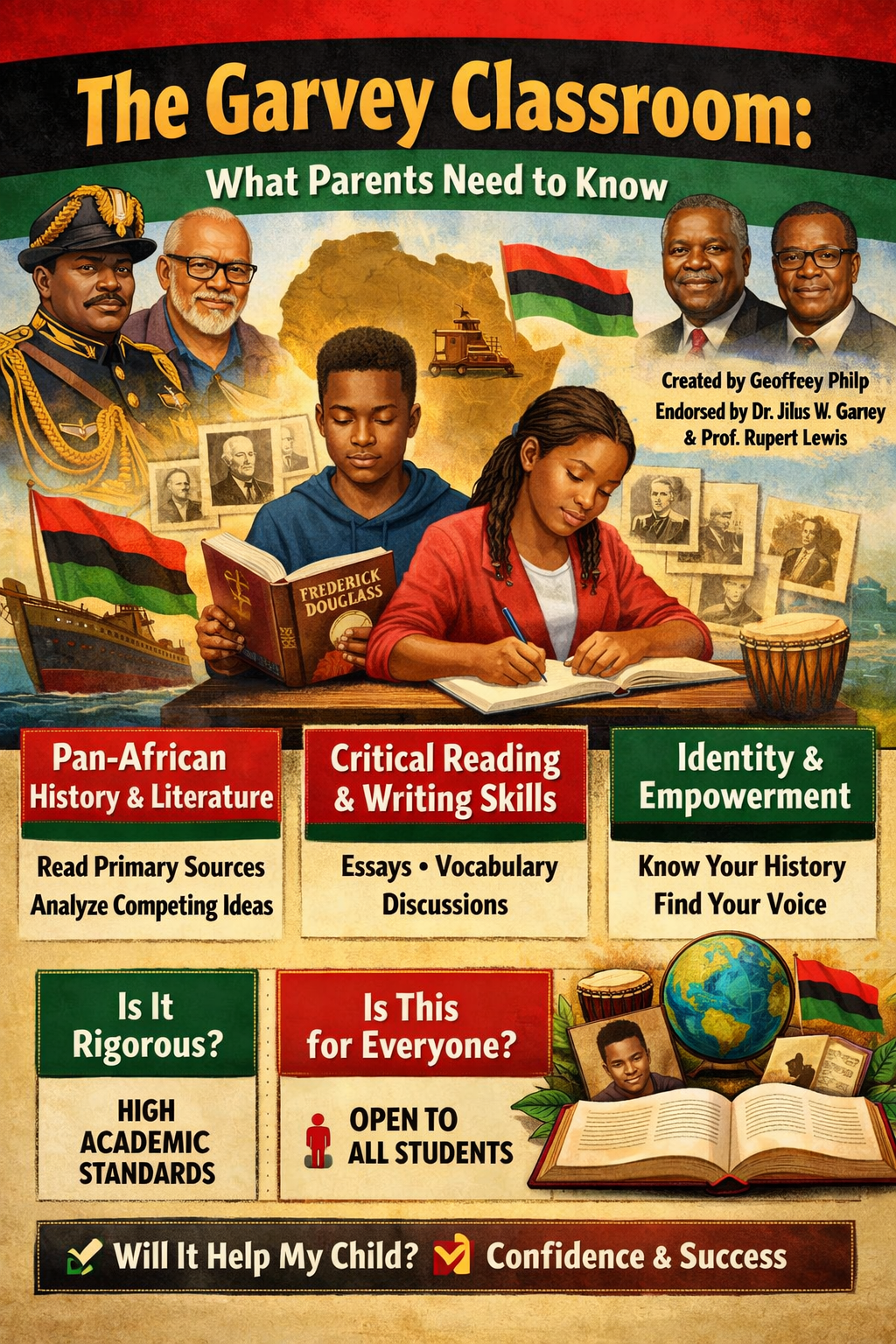
Your child is learning English Language Arts through The Garvey Classroom, a year-round curriculum for grades 6-8. Students read, write, and discuss their way through Pan-African history using the philosophy of Marcus Garvey as a framework. The curriculum was created by Geoffrey Philp, a Jamaican-born educator with 27 years of college teaching, six years as a middle school English teacher, and two decades of published Garvey scholarship. It is endorsed by Dr. Julius W. Garvey, Marcus Garvey’s son, and Professor Rupert Lewis of the University of the West Indies.
This page answers the most common questions parents ask.
What Will My Child Actually Learn?
Will reading and writing improve, or is this mostly history?
Reading and writing improve. History provides the content, but literacy is the outcome. Your child reads primary sources, writes essays using textual evidence, builds academic vocabulary, and participates in structured discussions. Every lesson aligns to Common Core State Standards for English Language Arts. The history makes the work meaningful. The ELA skills are what your child carries forward.
Will my child still learn grammar, essays, and vocabulary?
Yes. Students write in multiple genres across the year: reflective essays, argumentative essays, analytical paragraphs, and creative responses. Grammar and vocabulary are taught through the texts students read rather than in isolation. Academic language is introduced through a five-step protocol. Writing goes through structured revision cycles with teacher feedback. The mechanics of strong writing are built into every week.
Does this prepare them for high school and college work?
The skills developed here are the same abilities high school and college instructors expect: reading a complex text and identifying its argument, writing a clear essay supported by evidence, participating in discussion without dominating or withdrawing, and revising your own thinking based on new information. These skills do not expire. What this curriculum adds is a student who also knows who they are and where they come from. That grounding strengthens everything else.
Is it academically rigorous?
Students read at or above grade level. They analyze primary sources, compare competing arguments, and support their own positions with textual evidence. The academic demands are high. The cultural grounding makes those demands feel purposeful rather than arbitrary. Rigor and relevance work together here. Students who care about what they read write better about what they read.
Is This Political?
Are students being told what to believe?
Students are taught how to think, not what to think. They read primary sources, examine the reasoning behind historical decisions, compare competing strategies, and form their own conclusions in writing and discussion. The curriculum builds analytical skills. It does not prescribe conclusions.
Will my child feel pressured to agree with certain views?
Classroom discussion is structured around evidence and reasoning, not agreement. Students regularly examine figures who disagreed with each other. Malcolm X and Martin Luther King Jr. held opposing strategies for years. Booker T. Washington and W.E.B. Du Bois debated the purpose of education itself. Students learn to hold complexity, evaluate competing positions, and articulate their own thinking. Disagreement grounded in evidence is welcomed.
How are controversial topics handled?
Teachers receive training on facilitating sensitive discussions with care and discipline. Students are never required to share personal experiences. Reflection is structured, optional, and grounded in academic content. The curriculum maintains clear boundaries between instruction and therapy. Difficult history is taught honestly and age-appropriately, with developmental scaffolding that increases complexity from grade 6 through grade 8.
Are multiple perspectives included?
The curriculum covers figures from Jamaica, South Africa, Ghana, Kenya, Trinidad, Burkina Faso, Mozambique, and the United States. Students encounter organizers, writers, scientists, musicians, and political leaders who held different philosophies, pursued different strategies, and reached different conclusions. The scope is broad. The expectation is that students evaluate each figure’s reasoning on its own terms.
Does My Child Belong Here?
Is this only for Black students or for everyone?
The curriculum was designed for students of African descent across the diaspora. It addresses a specific gap: the systematic removal of African, Caribbean, and African American intellectual history from mainstream education. The pedagogical design centers on the identity development and cultural affirmation of Black students. All students benefit from accurate, rigorous history instruction and the literacy skills the curriculum builds. The content, however, is not designed to be culturally neutral. It is intended to serve the most underserved students.
Will students of other backgrounds feel excluded?
The analytical and literacy skills are universal. The questions the curriculum raises, including justice, responsibility, education, and self-knowledge, are human questions. Students of any background who engage seriously with this material become stronger readers, writers, and thinkers. The cultural specificity is the point, not a limitation. Restoring what was removed from education is correction, not exclusion.
Does it build understanding between students or separation?
Understanding. Students learn that their heritage crosses continents and centuries. They also learn that the problems these figures addressed are shared human problems. Marcus Garvey’s emphasis on self-knowledge, disciplined thinking, and personal responsibility applies broadly. The curriculum builds cultural confidence as the foundation for engaging with the wider world, not as a wall against it.
How are identity and culture discussed in mixed classrooms?
Through the academic work itself. Students read about real people, analyze real decisions, and discuss real consequences. Identity enters through the material, not through personal interrogation. No student is asked to represent their background or speak for a group. The discussion stays grounded in the text. Teachers are trained to keep conversations analytical, respectful, and evidence-based.
How Does This Affect Confidence and Behavior?
Will this help my child feel more confident in school?
Confidence built on knowledge and skill is durable. It does not depend on praise. It comes from doing hard intellectual work and discovering that you belong to a tradition of people who did the same. Research on racial identity development consistently shows that students with a strong, positive sense of cultural identity perform better academically, demonstrate greater resilience, and make healthier decisions. This curriculum builds that identity through the daily practice of reading, writing, and thinking.
Does it improve motivation to read and write?
Teachers and parents report that students engage more deeply with these materials than with standard ELA textbooks. The reason is straightforward: the stories matter to them. A student reading about Frederick Douglass teaching himself to read as an act of resistance is reading about something that connects to their own experience of learning. Engagement is the strongest predictor of academic growth. Students who care about the content produce better work.
Will students learn discipline and responsibility?
The Garvey Blueprint framework organizes learning around three principles practiced across the entire year: clarity of mind, purpose, and perseverance. These are not posters on a wall. They are practiced through the work. Students set learning goals, track their own progress, revise their writing through structured feedback, and reflect on their growth in quarterly portfolios. Discipline here means doing the work consistently, not compliance for its own sake.
How do discussions stay respectful?
The classroom establishes a community covenant in the first week of instruction. Discussion norms are explicit: use evidence, listen before responding, and disagree with the idea rather than the person. Teachers facilitate rather than lecture. Students practice these habits weekly across 39 weeks. By the end of the year, respectful academic discussion is a skill they own, not a rule imposed on them.
Is the Material Age-Appropriate?
How are the difficult parts of history taught to children?
Honestly and carefully. Students learn that Marcus Garvey lived in a time when Black people were treated unfairly and that he organized a movement to change those conditions. They study how historical figures confronted opposition, made difficult choices, and sustained effort through setbacks. The emphasis is on reasoning and agency rather than suffering. Students encounter people who acted, not people who were only acted upon.
Are topics introduced gradually?
Yes. Grade 6 begins with narrative and personal experience before moving into complex historical analysis. Grade 7 introduces competing perspectives and strategic debates. Grade 8 handles more nuanced tensions and unresolved questions. The developmental progression is intentional and scaffolded across the three-year sequence. Each year builds on the intellectual habits established the year before.
Do teachers receive guidance on sensitive conversations?
Teachers receive orientation and training before instruction begins. The training covers the Garvey Blueprint philosophy, facilitation of sensitive discussions, scaffolding and differentiation, and assessment practices. The curriculum provides psychological safety guidelines, content boundaries, and specific protocols for handling moments of disagreement or discomfort. Teachers are not left to improvise. The structure supports them.
Who Designed This and Why?
What qualifications does the author have?
Geoffrey Philp is a Jamaican-born author, poet, and educator. He taught middle school English for six years and spent 27 years as a professor and department chair at Miami Dade College. His published works include My Name Is Marcus, The Power of the Mind, Purpose, and Perseverance: A Marcus Garvey Reader, and Unstoppable You: Fifty Quotes from Marcus Garvey to Inspire Greatness. He is a Silver Musgrave Medal recipient and winner of the 2022 Marcus Garvey Award for Excellence in Education. He gathered more than 11,000 signatures supporting Marcus Garvey’s posthumous pardon. President Biden granted the pardon in January 2025.
Are primary sources used or interpretations?
Primary sources. Students read from Garvey’s own writings, including The Philosophy and Opinions of Marcus Garvey and Message to the People. They study Frederick Douglass’s autobiographical writings, Ida B. Wells’s investigative journalism, and speeches and letters from figures across the African diaspora. Every quote in the curriculum is verified against original sources. No paraphrased or widely-attributed-but-unverified quotes appear in any Garvey Classroom material. The scholarly foundation draws on Robert Hill, Rupert Lewis, Carter G. Woodson, and Angela Duckworth.
Is the curriculum tested in real classrooms?
The curriculum is currently implemented at The Garvey School in the Bronx, serving grades 6 through 8. Data collection protocols are built into the implementation to support evidence-based evaluation and advancement of the ESSA evidence tier. The instructional model draws on established research in culturally responsive pedagogy, story-driven instruction, and social-emotional learning. Schools adopting the curriculum in Year 1 contribute to the growing evidence base.
What Are the Long-Term Benefits?
Will this improve grades and test scores?
Every lesson builds the reading and writing skills measured on state ELA assessments: close reading, text-based evidence writing, argumentative composition, and academic vocabulary. The curriculum does not sacrifice rigor for relevance. It treats relevance as the pathway to rigor. Students who engage deeply with meaningful content produce stronger academic work. That shows up in classroom grades and on standardized assessments.
Does it help critical thinking and communication?
Critical thinking is the daily practice of this curriculum. Students evaluate decisions, weigh competing strategies, identify bias in sources, and support their own positions with evidence. Communication develops through structured academic discussions held every week and through writing that goes through multiple revision cycles. By the end of the year, students can articulate a reasoned position clearly, listen to disagreement without shutting down, and revise their thinking when the evidence demands it.
Will it prepare my child for college and careers?
The ability to read carefully, write clearly, think critically, and communicate with confidence is the foundation of success in college, in careers, and in civic life. This curriculum builds all four. What it adds beyond standard ELA programs is a student who understands themselves as part of an intellectual tradition that stretches across continents and centuries. That sense of belonging and purpose does not expire at graduation.
What skills will remain after the class ends?
The ability to read a complex text and understand what the author is actually arguing. The ability to write an organized essay that supports a claim with evidence. The ability to listen to someone you disagree with and respond with reasoning rather than reaction. The confidence that comes from knowing who you are and where you come from. These are permanent gains. They compound across every year of education that follows.
How Can I Support This at Home?
Ask your child what they read today and who they studied. Ask them what decision that person made and whether they agree with it. Ask them what they wrote about and what evidence they used. You do not need a background in history or education. The questions are simple: What problem did this person face? What did they do about it? Would you have done the same thing?
The curriculum includes family discussion prompts for dinner-table conversation. These prompts extend learning beyond the classroom and signal to your child that this work matters to your family.
Books from The Garvey Classroom are available for home reading. My Name Is Marcus introduces young readers to Garvey’s story. Unstoppable You provides fifty quotes for reflection and journaling. Both are available on Amazon.
Where Can I Learn More?
Full curriculum overview for schools: Culturally Responsive ELA Curriculum for Middle School
Teacher lesson plans and resources: Marcus Garvey Lesson Plans for Teachers, Grades 6–8
The Garvey Blueprint teaching framework: The Garvey Blueprint
Individual lesson plans: The Garvey Classroom on Teachers Pay Teachers
Books: Geoffrey Philp on Amazon
Newsletter: The Garvey Classroom on Substack
Questions: info@thegarveyclassroom.com