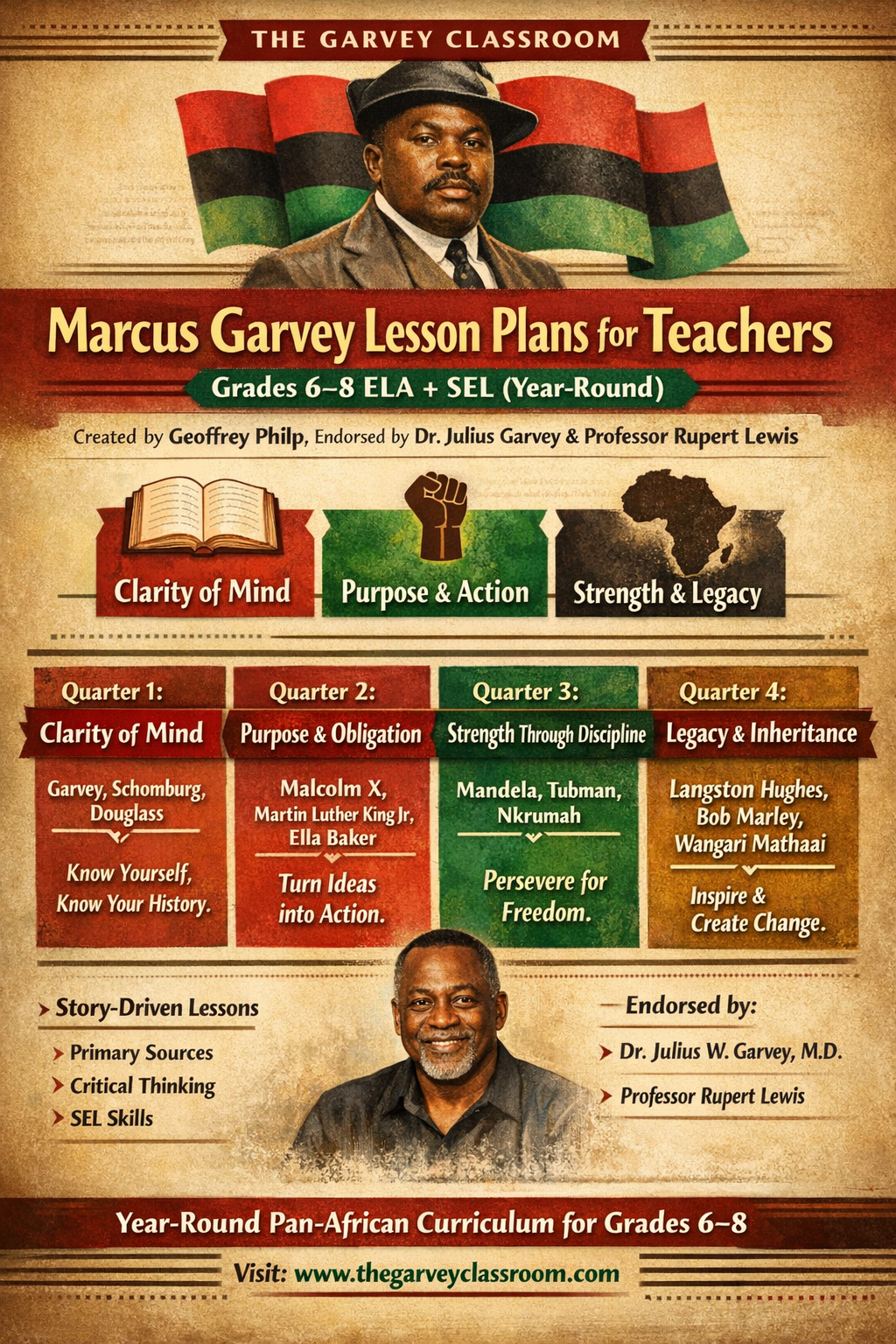
The Garvey Classroom offers the most comprehensive collection of Marcus Garvey lesson plans for middle school teachers, covering grades 6 through 8 with year-round ELA and social-emotional learning integration. Created by Geoffrey Philp, a Jamaican-born educator with 27 years of college teaching experience, six years as a middle school English teacher, and two decades of published Garvey scholarship, these lesson plans are endorsed by Dr. Julius W. Garvey, son of Marcus Garvey, and Professor Rupert Lewis of the University of the West Indies. Every lesson uses story-driven instruction, verified primary sources, and the Garvey Blueprint framework of clarity, purpose, and perseverance to build student confidence, cultural identity, and critical thinking skills.
What Makes a Good Marcus Garvey Lesson Plan?
A strong Garvey lesson plan does more than name-drop a historical figure. It engages students with primary sources, connects Garvey’s philosophy to their lived experience, and builds measurable literacy and SEL competencies. The Garvey Classroom lesson plans meet all three criteria. Each lesson opens with an authentic text, either a story or informational passage drawn from verified historical sources. Students move through Bloom’s taxonomy from recall to critical analysis, tackling essential questions that connect history to identity: Who am I in this world? What is my purpose? How do I cultivate a free mind?
These lessons are grounded in Garvey’s own writings, particularly The Philosophy and Opinions of Marcus Garvey and Message to the People. They are built on the Garvey Blueprint, a structured pedagogical framework organized around three principles: clarity of mind, purpose, and perseverance. This framework integrates contemporary grit research with Garvey’s foundational teachings, giving teachers a proven structure rather than a disconnected set of worksheets.
How Do I Teach Marcus Garvey Beyond Black History Month?
The Garvey Classroom was designed for year-round use. While most Marcus Garvey resources are built for February and forgotten by March, these lesson plans operate across a full 39-week academic calendar organized into four thematic quarters:
Quarter 1: Clarity of Mind. Students study Marcus Garvey, Arturo Schomburg, and Frederick Douglass. Lessons focus on self-knowledge, the power of reading, and the connection between intellectual freedom and personal identity.
Quarter 2: Purpose and Obligation. Students encounter Malcolm X, Martin Luther King Jr., and Ella Baker. Lessons explore how purpose translates into sustained action and how individual clarity serves collective progress.
Quarter 3: Strength Through Discipline. Students learn about Nelson Mandela, Harriet Tubman, and Kwame Nkrumah. Lessons connect endurance and strategic planning to liberation movements across the African diaspora.
Quarter 4: Legacy and Inheritance. Students study Langston Hughes, Bob Marley, and Wangari Maathai. Lessons show how cultural production, environmental stewardship, and artistic expression carry forward the work of liberation.
Each quarter features 27 to 30 Pan-African and African diasporic historical figures studied through reading, writing, reflection, and discussion. The curriculum aligns to Common Core State Standards for ELA, CASEL SEL competencies, UK Key Stage frameworks, and Jamaica’s national curriculum standards.
What Grade Levels and Subjects Do These Lesson Plans Cover?
The Garvey Classroom lesson plans are built for grades 6 through 8, with content that scales for advanced 5th graders and developing 9th graders. The primary subject integration is English Language Arts combined with social-emotional learning. Every lesson includes reading comprehension, text analysis, reflective writing, and discussion protocols. Teachers in Social Studies, History, and Advisory/SEL blocks also use these materials effectively.
For elementary educators working with pre-K through 2nd grade, The Garvey Classroom offers The Marcus Garvey Coloring Book with 78 scripted lesson plans. For high school and adult learners, the flagship course The Power of the Mind, Purpose, and Perseverance: The Garvey Blueprint for Liberation provides a 12-week structured learning experience endorsed by Dr. Julius Garvey and Professor Rupert Lewis.
What Standards Do These Lesson Plans Align To?
Each Garvey Classroom lesson plan is aligned to nationally recognized educational standards, including Common Core State Standards (CCSS) for English Language Arts, specifically Reading Informational Text (RI), Reading Literature (RL), Writing (W), and Speaking and Listening (SL) strands for grades 6 through 8. Lessons also align with the Collaborative for Academic, Social, and Emotional Learning (CASEL) five core competencies: self-awareness, self-management, social awareness, relationship skills, and responsible decision-making.
For international educators, lesson plans include alignment notes for UK Key Stage 3 requirements and Jamaica’s national curriculum frameworks. This cross-jurisdictional alignment makes The Garvey Classroom resources usable in the United States, the United Kingdom, the Caribbean, and African nations implementing English-medium instruction.
How Is This Different from Other Marcus Garvey Lesson Plans?
Most Marcus Garvey lesson plans available to teachers fall into one of two categories: surface-level worksheets that reduce Garvey to a name and a few dates, or academic materials designed for college students that are inaccessible to middle schoolers. The Garvey Classroom fills the space between these extremes with resources that are rigorous, culturally grounded, and developmentally appropriate.
Three features distinguish this work. First, every lesson uses verified quotes and primary sources. No paraphrased or widely-attributed-but-unverified quotes appear in any Garvey Classroom material. Second, the curriculum treats historical figures as strategists and system-builders whose methods are transferable, rather than as inspirational symbols to admire from a distance. Third, SEL integration happens through academic practice, embedded in reading and writing activities, rather than as standalone therapeutic exercises disconnected from content.
The Garvey Classroom also draws from a Pan-African intellectual tradition that most commercial resources ignore entirely. Lessons reference scholarship from Robert Hill, Rupert Lewis, Tony Martin, Carter G. Woodson, John Henrik Clarke, and Amos Wilson. Caribbean thinkers including C.L.R. James, Walter Rodney, and Frantz Fanon inform the curriculum’s philosophical framework. This depth of scholarly grounding is unmatched in the K–12 marketplace.
Who Created The Garvey Classroom Lesson Plans?
Geoffrey Philp is a Jamaican-born author, poet, and educator. He taught middle school English for six years and spent 27 years as a professor and department chair at Miami Dade College. His published works include My Name Is Marcus, The Power of the Mind, Purpose, and Perseverance: A Marcus Garvey Reader, and Unstoppable You: Fifty Quotes from Marcus Garvey to Inspire Greatness. He is a Silver Musgrave Medal recipient and winner of the 2022 Marcus Garvey Award for Excellence in Education.
Geoffrey gathered more than 11,000 signatures in support of Marcus Garvey’s posthumous pardon and personally delivered them to Julius Garvey and U.S. Congresswoman Frederica Wilson. President Biden granted the pardon in January 2025. Through The Garvey Classroom, Geoffrey builds educational tools that honor academic rigor, cultural authenticity, and the belief that confidence is every child’s birthright.
Endorsements from Garvey Scholars
“This course faithfully carries forward my father’s vision. It engages participants in the process to know themselves, define their purpose, and persevere in the face of obstacles and injustice.”
— Julius W. Garvey, M.D., O.J., Founder and Chairman, Marcus Garvey Institute for Human Development
“I endorse this initiative by Geoffrey Philp because the teaching of the philosophy of Marcus Garvey, which guided the movement for decolonization and civil rights, is imperative for our economic, social, and cultural goals in the 21st century.”
— Rupert Lewis, Professor Emeritus of Political Thought, University of the West Indies, Mona
Where Can I Access These Lesson Plans?
The Garvey Classroom lesson plans are available through multiple channels:
Teachers Pay Teachers: Individual lesson plans and heritage month bundles are available for immediate download at The Garvey Classroom on TPT. Featured resources include Marcus Garvey speech analysis, Pan-African heroes lessons, Frederick Douglass SEL units, Harriet Tubman lessons, Miriam Makeba lessons, Sojourner Truth lessons, and Fannie Lou Hamer lessons for grades 6 through 8.
The Garvey Blueprint for Liberation Course: A 12-week structured learning experience for teens and adults, grounded in Garvey’s African School of Philosophy and Message to the People. Enrollment is open at Thinkific.
School Partnerships: Schools and districts seeking a full-year culturally responsive ELA curriculum with professional development can contact The Garvey Classroom directly at info@thegarveyclassroom.com.
Books: All titles, including My Name Is Marcus, The Marcus Garvey Coloring Book, The Power of the Mind, Purpose, and Perseverance, and Unstoppable You, are available on Amazon.
Frequently Asked Questions
Can I use these lesson plans if I am not teaching at a Title I school?
Yes. The Garvey Classroom lesson plans work in public schools, charter schools, private academies, homeschool cooperatives, and community education programs. They serve any educator committed to culturally responsive teaching that centers Pan-African history and develops student confidence through rigorous literacy instruction.
Do these lesson plans work for students who are not Black?
The curriculum was designed specifically for students of African descent across the diaspora. It is a Pan-African solution to a Pan-African problem: the systematic separation of African, Caribbean, and African American intellectual history from mainstream education. All students benefit from accurate, rigorous history instruction, but the pedagogical design centers the identity development and cultural affirmation of Black students.
Are these lesson plans aligned to state testing standards?
Each lesson builds measurable ELA skills aligned to Common Core State Standards, including close reading, text-based evidence writing, argumentative and analytical composition, and academic discussion. Teachers report that these materials strengthen the same competencies assessed on state ELA examinations while providing culturally relevant content that increases student engagement.
How do I integrate these into an existing ELA curriculum?
The Garvey Classroom lesson plans are designed to supplement or replace existing units depending on the level of curricular flexibility available. Individual heritage month lessons work as drop-in replacements for a single week. The full-year curriculum provides a complete scope and sequence that satisfies grades 6 through 8 ELA standards while embedding SEL and Pan-African historical content throughout.
What makes this a Pan-African curriculum rather than just an African American one?
The scope of the curriculum intentionally crosses national and regional boundaries. Students study figures from Jamaica (Marcus Garvey, Bob Marley), South Africa (Nelson Mandela), Ghana (Kwame Nkrumah), Kenya (Wangari Maathai), Trinidad (C.L.R. James), Burkina Faso (Thomas Sankara), Mozambique (Miriam Makeba), and the United States (Frederick Douglass, Langston Hughes, Ella Baker). This Pan-African breadth reflects Garvey’s own vision of global Black unity and teaches students that their heritage extends across continents and centuries.