Category: The Garvey Classroom

  • Mia Mottley Just Made History Again. Your Students Should Know Her Name.

    Mia Mottley Just Made History Again. Your Students Should Know Her Name.

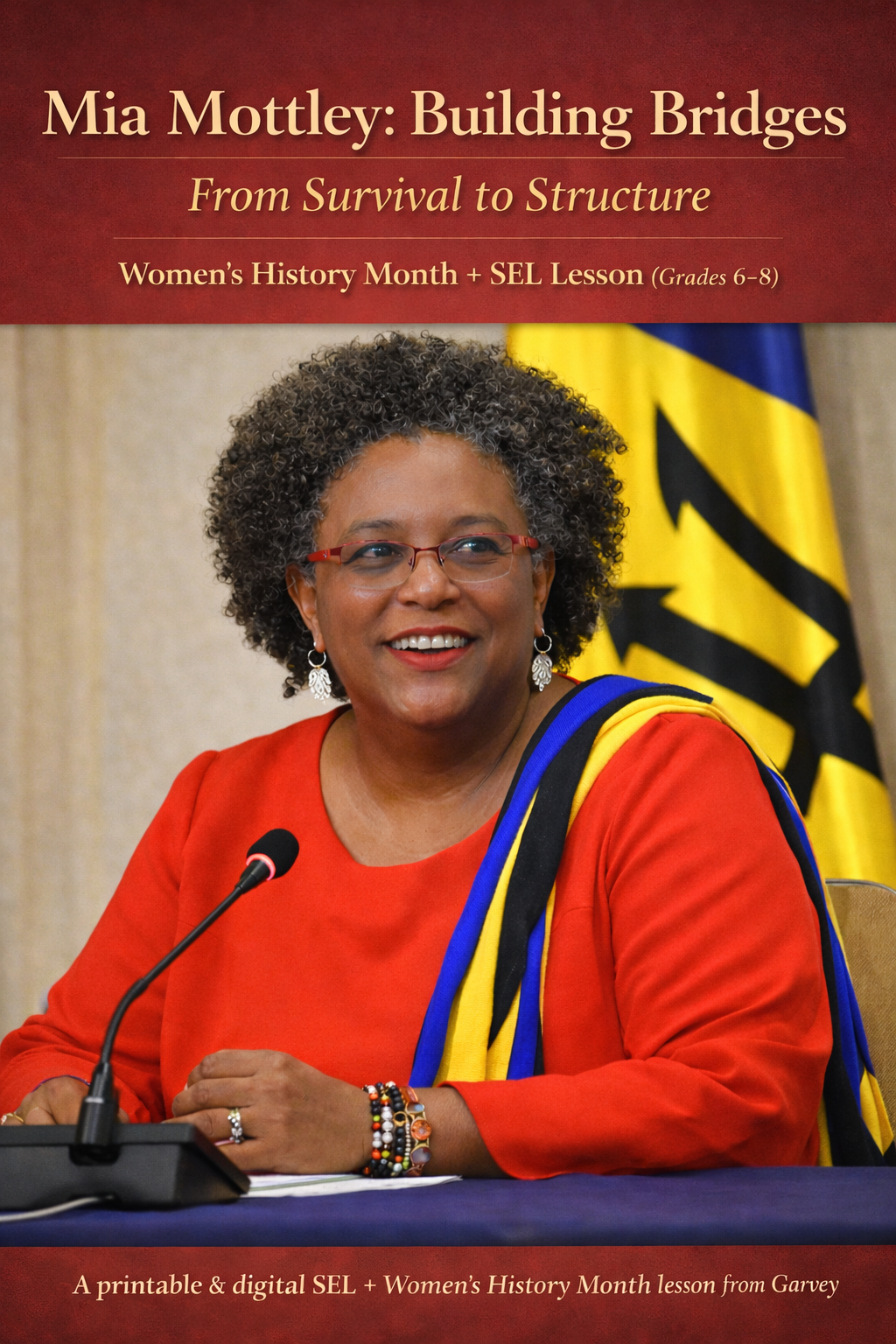
    On February 11, Barbados Prime Minister Mia Mottley won a historic third consecutive term, her party sweeping all 30 seats for the third time. She is the longest-serving female head of state in the world. And most students have never heard of her.

    Three days ago, the people of Barbados gave Mia Amor Mottley a mandate that no other Caribbean leader of her generation has received. The Barbados Labour Party captured every seat in the House of Assembly for the third consecutive election. No opposition member holds a single seat. The margin is not close. The margin is total.

    Mottley stood before her country and said what she has said since 2018: “We did not come simply to hold office. We have come to make Barbados better, and to make your lives better.”

    That sentence carries weight because Mottley has spent the years between elections proving she means it. She led Barbados from a constitutional monarchy to a republic. She stood at COP26 in Glasgow and told world leaders that two degrees of warming was a death sentence for island nations. She launched the Bridgetown Initiative, a plan to restructure how wealthy nations loan money to countries hit by climate disasters. She did not beg. She proposed mechanisms. She built coalitions with nations across Africa, the Pacific, and Latin America.

    And now her name is circulating as a leading candidate to become the next Secretary-General of the United Nations.

    Why This Matters for Your Classroom

    Women’s History Month is two weeks away. Teachers across the country are planning lessons right now. Most of those lessons will cover the same names they covered last year and the year before. Harriet Tubman. Rosa Parks. Susan B. Anthony. Important women. But a curriculum that only teaches students about leaders from the past teaches them that leadership is something that already happened.

    Mia Mottley is making history in real time. She is not in a textbook. She is in the news this week. When students learn about Mottley, they encounter a living leader who shows them that small nations produce world-changing voices, that coalition-building is a practical skill, and that placing truth on record is both an act of courage and a strategy.

    The connection to the Pan-African tradition runs deep. Barbados is the same soil that produced Shirley Chisholm, whose mother came from the island, whose grandmother taught her she was somebody. Chisholm carried Barbados in her voice. Mottley carries it in her strategy. The line runs unbroken.

    A Lesson Ready to Teach

    We built the Mia Mottley lesson for exactly this kind of moment. “Building Bridges From Survival to Structure” gives students a focused biography, vocabulary tied to climate finance and international leadership, evidence-based comprehension questions, 10 SEL reflection prompts, a graphic organizer, and a systems-thinking extension activity that moves students from biography to understanding how power actually works.

    The lesson connects to CASEL SEL Competencies in Social Awareness and Responsible Decision-Making. It aligns with Common Core ELA standards for citing evidence, determining central ideas, and writing routinely for reflection. It works for whole-group instruction, small-group work, independent study, or emergency sub plans. Everything is in the packet. No prep required.

    Mia Mottley: Building Bridges From Survival to Structure

    A complete SEL + Women’s History Month lesson for grades 6–8. Teacher guide, student biography, vocabulary, comprehension questions, SEL reflections, graphic organizer, quiz with answer key, and extension activity.

    Get This Lesson — $4.75: https://www.teacherspayteachers.com/Product/Mia-Mottley-Womens-History-Month-SEL-Lesson-Grades-68-15367954

    The Full Collection

    Mia Mottley is one voice in a larger tradition. Our Women’s History Month Bundle includes eight complete lesson packets covering Ella Baker, Harriet Tubman, Sojourner Truth, Ida B. Wells, Fannie Lou Hamer, Septima Clark, Shirley Chisholm, and Miriam Makeba. Each lesson follows the same structure: biography, vocabulary, comprehension questions, SEL reflection, graphic organizer, and quiz. Together, they give students a month-long look at women who built movements, not monuments.

    Add the Mia Mottley lesson to the bundle, and your students will meet nine women across two centuries of leadership. From the Underground Railroad to the United Nations stage. From speaking truth with nothing to speaking truth with a nation behind you.

    Women’s History Month Bundle: 8 SEL Lessons

    Eight complete lesson packets. Grades 6–8. Print and digital. $35.99 (save 25%).

    Get the Bundle — $35.99: https://thegarveyclassroom.com/womens-history-month-curriculum/

    Mottley said it plainly in her victory speech: “Our mission first and foremost is to stop poor people from being poor and to remove injustice wherever it exists to create opportunities for people.” That sentence could spark a class discussion that lasts the entire period. It could anchor a writing prompt. It could change how a student thinks about what leadership looks like.

    She won three days ago. Women’s History Month starts in two weeks. The timing is yours.

    FAQ

    Who is Mia Mottley?

    Mia Amor Mottley is the first female Prime Minister of Barbados, first elected in 2018. She won a historic third consecutive term on February 11, 2026, with her Barbados Labour Party sweeping all 30 parliamentary seats. She is the longest-serving female head of state in the world and a leading global voice for climate justice and debt reform for vulnerable nations.

    Why should I teach Mia Mottley during Women’s History Month?

    Mia Mottley is a living leader making history in real time. She gives students a model of Caribbean women in global leadership, coalition-building as a practical skill, and truth-telling as strategy. Her story connects to Shirley Chisholm’s Barbadian heritage, climate justice, and responsible decision-making, all aligned to CASEL SEL competencies and Common Core ELA standards for grades 6 through 8.

    What is included in the Mia Mottley lesson plan?

    The lesson includes a teacher guide with pacing and differentiation strategies, a student biography written at 6th-grade reading level, five vocabulary terms tied to climate finance and international leadership, ten comprehension questions, ten SEL reflection prompts, a graphic organizer, a multiple-choice quiz with answer key, and a systems-thinking extension activity. It works for whole-group instruction, small groups, independent study, or emergency sub plans. No prep required.
  • The Garvey Classroom Resources

    The Garvey Classroom Resources

    The Garvey Classroom was created to give our children the tools to become confident, lifelong learners.

    We build resources that help African children in the West remember who they are, trust their minds, and walk with purpose.

    Parents, teachers, and community elders will find tools here that strengthen identity, clarity, and belonging in our children.

    Start Here

    For parents

    Begin with the children’s books and short videos. These stories and daily teachings help your child grow a strong mind and a grounded sense of self.

    For educators

    Use our lesson plans, ROOTS reflections, and writing guides. These resources help you create classrooms that protect imagination and build confidence.

    For community leaders

    Use our stories and study circles to support youth programs, church groups, and after school spaces.

    Books for Home and Classroom

    Amazon Author Page

    https://www.amazon.com/stores/author/B001K819L0

    For Parents and Children

    My Name Is Marcus

    • Amy’s Christmas Gift

    • The Marcus Garvey Coloring Book 

    For Teens and Adults

    The Power of the Mind, Purpose, and Perseverance: A Marcus Garvey Reader

    Unstoppable You: Fifty Quotes from Marcus Garvey to Inspire Greatness

    All titles are available from the Amazon author page: https://www.amazon.com/stores/author/B001K819L0

    Amy’s Christmas Gift (en Español) will be released soon.

    Lesson Plans and Classroom Tools

    The Garvey Classroom on Teachers Pay Teachers

    https://www.teacherspayteachers.com/store/the-garvey-classroom

    Featured resources include:

    • Marcus Garvey speech analysis

    • Pan African heroes lessons

    • Social emotional learning units rooted in confidence and purpose

    • Writing and composition tools that build clarity and flow

    Video Learning for Children and Families

    Unstoppable Heroes: A children-centered video podcast series.

    Daily Garvey Wisdom: Short daily videos that teach clarity, purpose, and perseverance.

    The Work of Freedom: A teaching series with Elder Grace and Elder Samuel.

    YouTube Channel

    https://www.youtube.com/@GeoffreyPhilp

    Courses and Learning Experiences

    • The Garvey Blueprint for Liberation

    • Marcus Garvey in the Age of AI

    • Teacher Training Circles

    Stay Connected

    Newsletter: https://thegarveyclassroom.substack.com

    TikTok: https://www.tiktok.com/@mynameismarcusgarvey

    Amazon Author Page: https://www.amazon.com/stores/author/B001K819L0

    Teachers Pay Teachers: https://www.teacherspayteachers.com/store/the-garvey-classroom

  • How Marcus Garvey Taught Us to Assert Our Full Humanity.

    How Marcus Garvey Taught Us to Assert Our Full Humanity.

    I was in my late teens when I discovered The Philosophy and Opinions of Marcus Garvey. I knew that Garvey was saying something important, but at that time, I neither had the skill nor the experience to process what he was teaching. His words felt urgent and necessary, but the meaning eluded me. Yet, I kept getting hints about the depth of his message, especially when I decided to become a teacher at West Miami Middle School.

    Even though I had a master’s degree in English, the State of Florida mandated that I take education courses through the Department of Education. At first, I thought it was a waste of time—more red tape standing between me and my students. Then, something shifted as I studied developmental education and encountered the theories of Piaget, Erikson, and especially Maslow.

    When I combined my newfound knowledge of human development with my ongoing study of Garvey, everything clicked. I realized that Garvey wasn’t just giving speeches or building organizations—he was teaching Black people how to assert our full humanity in a country designed to deny it.

    His quotes didn’t just inspire; they mapped perfectly onto Maslow’s hierarchy of needs, but with a crucial difference. They transformed universal human needs into a specific survival and liberation guide for Black people navigating the particular violence of life in America.

    How Marcus Garvey’s Quotes Address the Specific Reality of Black Needs in America

    Abraham Maslow proposed that all humans are motivated by five levels of needs: physiological, safety, love and belonging, esteem, and self-actualization. When I examine Marcus Garvey’s quotes through this lens, I see something more specific and urgent: a liberation strategy that speaks to what it means to pursue human needs through the Black experience. Garvey’s teachings systematically address how anti-Black racism distorts and denies every level of human motivation.

    The genius of Garvey’s approach becomes clear when we understand that he wasn’t speaking about abstract human development. He was speaking to Black people whose access to basic humanity was constantly under attack. His quotes become instructions for claiming and protecting our humanity within systems designed to crush it.

    Level 1: Physiological Needs – When Being Black Makes Survival Political

    At the foundation of Maslow’s pyramid sit our most basic needs: food, water, shelter, and safety. For Black people in America, even these fundamental requirements become sites of struggle. According to the Federal Reserve’s 2022 Survey of Consumer Finances, the median wealth gap between white and Black households reached $240,120, meaning Black families have only $44,890 in median wealth compared to $285,000 for white families. When Garvey declared, “Chance has never yet satisfied the hope of a suffering people,” he was addressing the specific reality that Black communities couldn’t rely on American systems to meet even our most basic needs.

    Garvey understood that waiting for white America to feed, house, and employ us was waiting for death. He launched the Negro Factories Corporation, established the Black Star Line shipping company, and created businesses that could meet physiological needs through Black ownership. His quote speaks to the urgency of Black self-reliance: “A race that is solely dependent upon another for economic existence sooner or later dies.”

    This wasn’t abstract economic theory—it was Black survival strategy. Today’s food deserts in Black neighborhoods, predatory lending that denies Black homeownership, and employment discrimination prove that meeting basic needs while Black requires intentional community-building and economic independence that white Americans take for granted.

    Level 2: Safety and Security – When Protection Becomes Self-Defense

    Once physiological needs are met, humans seek safety and security. Garvey recognized that for Black people in America, traditional forms of protection—police, courts, social services—often became sources of danger rather than safety.

    Data from the U.S. Department of Education shows that Black students are 3.8 times more likely to receive out-of-school suspensions than white students and 2.3 times more likely to be referred to law enforcement, demonstrating how systems designed to protect actually criminalize Black children. He advocated for intellectual and institutional self-defense as the only reliable protection for Black communities.

    “The man who is not able to develop and use his mind is bound to be the slave of the other man who uses his mind,” Garvey taught. Through the UNIA, he established schools, trained the Black Cross Nurses, and created newspapers because he understood that for Black people, knowledge was protection from violence and exploitation.

    Garvey’s emphasis on mental development as security remains essential when Black people must navigate systems designed to trap and harm us. We cannot depend on America to keep us safe—we must create our own safety through knowledge, organization, and community control.

    Level 3: Love and Belonging – Healing What White Supremacy Broke

    The third level of Maslow’s hierarchy addresses our need for love, belonging, and connection. For Black people in America, anti-Black racism systematically destroys our sense of belonging and sometimes to each other.

    According to the Substance Abuse and Mental Health Services Administration, 19.7% of Black adults experienced a mental health condition in the past year, yet only 39% of Black Americans received mental health services compared to 52% of white Americans. Garvey’s words attempt to heal these specific psychological wounds by creating a global sense of Black belonging that transcends the boundaries of white supremacy.

    When he proclaimed that Black skin was “a glorious symbol of national greatness,” he was directly countering the daily messages that told Black people we were unwanted, unworthy, and unlovable. His vision extended beyond individual healing to collective belonging: “Africa for the Africans—those at home and those abroad!” he declared, creating a sense of global Black family that made us citizens of something larger than America’s limited imagination.

    This quote addresses the love and belonging needs that white supremacy systematically attacks from birth. It provides the counter-narrative that Black communities need to feel worthy of love and capable of creating our own systems of care and connection when America fails us. We belong to each other, and that belonging transcends what any nation offers or denies us.

    Level 4: Esteem and Recognition – Building Black Standards in a White World

    The fourth level involves esteem needs—both self-respect and recognition from others. Garvey understood that Black people would never gain true esteem by seeking approval from systems designed to diminish us.

    The National Assessment of Educational Progress shows that Black students scored 30 points lower than white students in 8th-grade mathematics, while only 57% of Black students have access to the full range of math and science courses necessary for college readiness, compared to 71% of white students. He advocated for creating independent Black standards of excellence and recognition that didn’t require white validation.

    “We must canonize our own saints, create our own martyrs, and elevate to positions of fame and honor Black men and women who have made distinct contributions to our racial history,” he taught. Through parades, ceremonies, and public celebrations, Garvey made Black achievement visible and honored within Black communities, regardless of whether white America acknowledged our greatness.

    This quote remains revolutionary because it rejects the idea that white approval is necessary for Black worth. It calls for the creation of Black cultural institutions that celebrate our excellence on our own terms, building the esteem that healthy human development requires. When America tells us we’re nothing, we must have our own mirrors that reflect our true magnificence back to us.

    Level 5: Self-Actualization – Becoming Fully Human Despite America

    At the pinnacle of Maslow’s hierarchy sits self-actualization: the realization of one’s full potential. For Black people in America, self-actualization requires overcoming centuries of programming that tells us we’re less than human. Garvey’s most powerful quotes call Black people to our highest possibilities while acknowledging the specific barriers we face.

    “Up, you mighty race, accomplish what you will!” he proclaimed, seeing no limits to Black potential when properly nourished and developed despite American attempts to stunt our growth. His famous declaration, “Liberate the minds of men and ultimately you will liberate the bodies of men,” speaks to the ultimate goal of Black liberation: becoming fully human in a context designed to keep us fractured.

    When he said, “God and Nature first made us what we are, and then out of our own created genius we make ourselves what we want to be,” he was describing Black self-actualization as both birthright and resistance. These quotes don’t just inspire individual achievement; they call for collective Black self-actualization where entire communities realize their full potential as an act of defiance against white supremacy’s limitations.

    Why Marcus Garvey Quotes and the Hierarchy of Needs Remain Essential for Black Liberation

    When I look at contemporary movements for Black liberation, I see Garvey’s blueprint everywhere. From mutual aid networks addressing the specific ways anti-Blackness creates food insecurity to community education initiatives building safety through knowledge that centers Black experiences, the pattern persists. What makes Garvey’s approach timeless is its specificity to the Black experience in America.

    Unlike universal approaches to human development that ignore how racism distorts basic needs, Garvey’s quotes provide a framework specifically designed for Black people navigating white supremacy. They recognize that our liberation requires meeting all human needs while simultaneously resisting the systems that deny us access to those needs.

    The hierarchy also reveals why surface-level diversity initiatives fail to create lasting change for Black communities. When systems address esteem needs through representation while ignoring how anti-Blackness creates poverty, educational inequality, and violence, the foundation crumbles. We need strategies that understand how being Black in America transforms every level of human need into a site of struggle and resistance.

    Building Black Liberation with Garvey’s Blueprint

    Marcus Garvey quotes and the hierarchy of needs offer us more than historical insight—they provide a roadmap for contemporary Black liberation work that understands our specific context. When we map current organizing strategies onto this framework, we can identify gaps and strengthen our approaches to building Black power in America.

    The work begins with asking specifically Black questions: How are we addressing physiological needs through Black cooperative economics and mutual aid when white systems fail us? How are we building safety through Black-controlled education and community defense when police and courts harm us? How are we fostering belonging through Black cultural celebration and global connection when America rejects us? How are we creating independent Black standards of esteem and recognition that don’t require white approval? Finally, how are we calling Black people to our highest potential while working toward collective liberation from white supremacy?

    These questions guide Black liberation work that builds sustainable freedom. They honor Garvey’s understanding that our liberation must be as specific as the oppression we face and as complete as the Black human beings it seeks to free.

    Ready to explore how Marcus Garvey’s wisdom can guide your own growth and development? Discover Unstoppable You, a comprehensive guide that connects Garvey’s most powerful quotes to daily practices, historical heroes, and actionable steps for personal and collective liberation.

    Works Cited

    Garvey, Marcus. Philosophy and Opinions of Marcus Garvey. Edited by Amy Jacques Garvey, The Majority Press, 1923.

    Garvey, Marcus. Selected Writings and Speeches of Marcus Garvey. Edited by Bob Blaisdell, Courier Corporation, 2012.

    Maslow, Abraham H. “A Theory of Human Motivation.” Psychological Review, vol. 50, no. 4, 1943, pp. 370-396.

    Martin, Tony. Race First: The Ideological and Organizational Struggles of Marcus Garvey and the Universal Negro Improvement Association. Majority Press, 1976.

    Links

    Marcus Garvey Self-Reliance Movement Explained – The Garvey Classroom