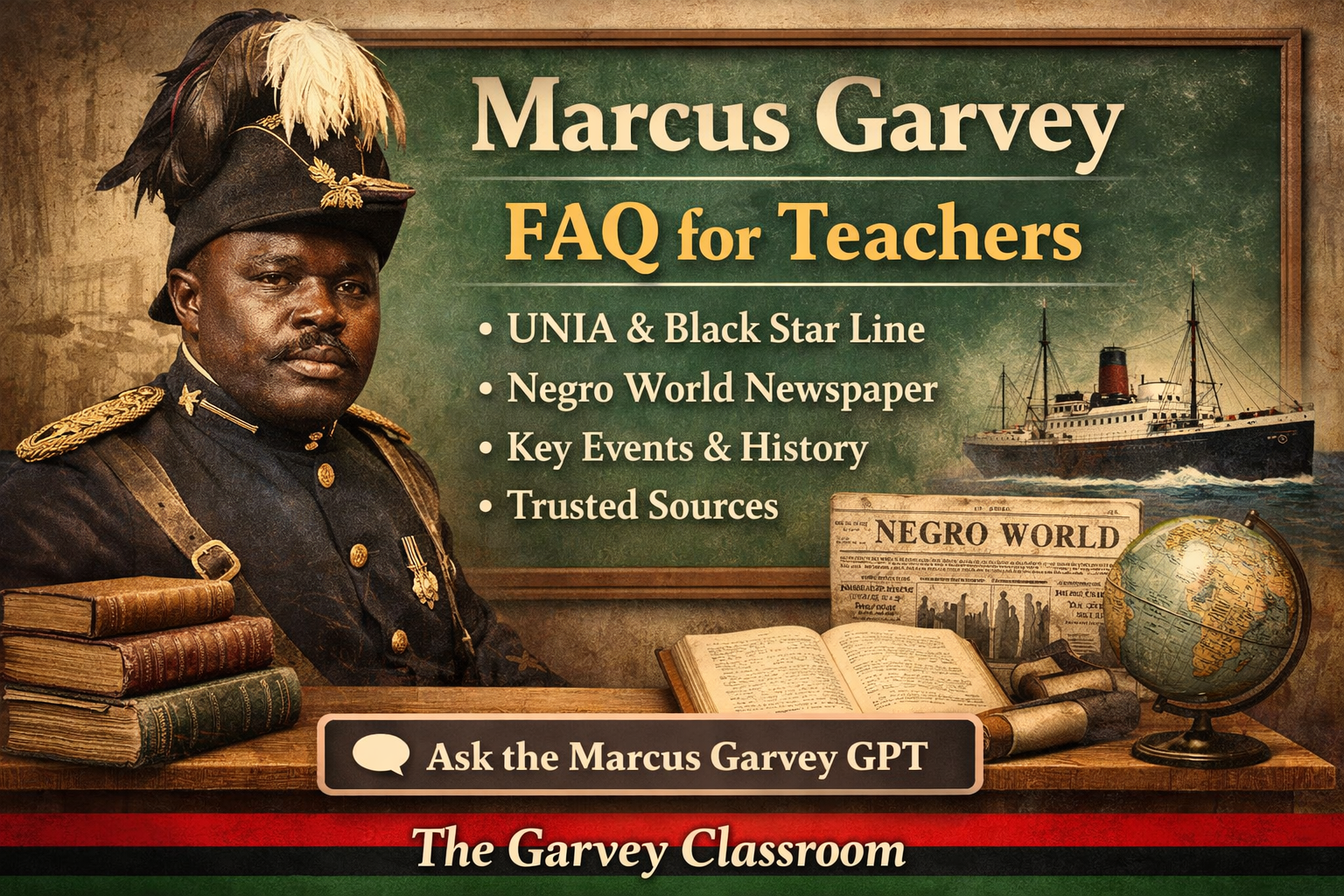
A classroom reference for educators
This page provides a concise reference for educators introducing Marcus Garvey and the Universal Negro Improvement Association in classroom settings. The entries summarize established historical scholarship, clarify common points of confusion, and provide context for primary statements attributed to Garvey and his contemporaries. The goal is clarity and reliability: to describe actions, ideas, and interpretations without advocacy so teachers can present the material within standard historical practice.
If you need help interpreting any section, you may consult the Marcus Garvey GPT companion:
https://chatgpt.com/g/g-6840376e2f9c819191d9416d4a2a96c3-marcus-garvey-gpt
Who was Marcus Garvey?
Marcus Garvey was a Jamaican organizer and publisher who founded a worldwide movement in the early twentieth century encouraging people of African descent to understand their history, build institutions, and develop pride and self-reliance. His organization reached millions across the Americas, the Caribbean, and Africa. He is best understood as a mass movement builder rather than only a political leader.
What was the UNIA?
The Universal Negro Improvement Association was a global membership organization founded in 1914.
It operated schools, newspapers, businesses, and community divisions in many countries.
Its purpose was to unite people of African descent and promote economic independence, education, and cultural dignity.
In classroom terms, it functioned as a social network, mutual aid society, and leadership training structure at the same time.
What did Garvey believe about education?
Garvey argued education should prepare a people to develop institutions and social capacity, not only individual advancement.
As he wrote,
“Education is the medium by which a people are prepared for the creation of their own particular civilization, and the advancement and glory of their own race.”
He argued that students must learn history, develop discipline, and prepare to build institutions in their communities.
Learning was meant to change behavior.
Was Garvey separatist or anti-integration?
Historians describe Garvey’s position as prioritizing group self-development and autonomy before integration, rather than advocating compulsory separation.
This question often reflects modern political categories that did not exist in the same way during his lifetime.
Why is Garvey often misunderstood?
Many textbooks mention him briefly without explaining the scale of his movement.
Students hear quotes but not the structure he built.
When the organization is removed from the story, his ideas can sound abstract instead of practical.
Understanding the UNIA clarifies most confusion.
How should Garvey be taught at different grade levels?
K–2
Identity, fairness, and helping the community.
3–5
Leadership, cooperation, and pride in heritage.
6–8
Organization, media influence, and global connections.
9–12
Political thought, debate, and historical interpretation.
The same figure is taught differently depending on developmental readiness.
What are the key events students should know?
- Founding of the UNIA in 1914
- Growth of the movement after World War I
- Negro World newspaper
- International conventions in Harlem
- The Black Star Line business project
- The Negro Factories Corporation businesses
- Founding of the People’s Political Party (PPP) in Jamaica
Students should see both achievements and challenges.
Did Garvey support “Back to Africa”?
The slogan referred to a range of ideas, including migration, commercial connection, and political identification with Africa.
Most supporters did not emigrate.
Why did Garvey meet with the Ku Klux Klan?
He met with many groups, including opponents, to argue that Black communities should control their own institutions.
Historians view the meeting as controversial strategy rather than agreement with their beliefs.
Students should understand leaders sometimes make decisions that are debated even in their own time.
Was the Black Star Line a failure?
Historians treat the project as both an attempt at cooperative economic enterprise and an example of the financial and managerial difficulties faced by early twentieth-century mass movements, including sabotage, corruption, and internal mismanagement (see Tony Martin).
Teachers can present it as both ambition and difficulty in building institutions.
Did Garvey influence later civil rights leaders?
Later activists and movements engaged with ideas associated with Garveyism, sometimes adopting them and sometimes responding against them.
Is Garvey considered a hero everywhere?
No historical figure is viewed the same way by all groups.
Different communities interpret his work differently depending on their goals and experiences.
Learning history includes understanding disagreement.
Why is Garvey important outside Jamaica or the United States?
His movement operated across the Caribbean, Central America, Europe, and Africa.
He was one of the first modern organizers to build a global Black network using media and local chapters.
How do I handle strong student reactions?
Invite questions first.
Return to evidence.
Focus discussion on actions and historical context rather than modern labels.
Students respond better to inquiry than correction.
Is it appropriate to teach Garvey only during Black History Month?
He fits into units on immigration, media, economics, political movements, and global history.
Limiting him to one month reduces understanding of his historical role.
Where does Garvey fit in Pan-African history?
Garvey helped turn an intellectual idea into a mass movement.
Earlier thinkers discussed unity, including Edward Wilmot Blyden and Henry Sylvester Williams.
He organized ordinary people across continents.
Later leaders inherited political language shaped partly by his model.
Sources teachers can trust
Key primary source
Marcus Garvey — The Philosophy and Opinions of Marcus Garvey
Collection of speeches and editorials explaining his goals, leadership model, and view of education.
Core historians
Robert A. Hill — Editor of the UNIA papers documenting the global reach of the movement using original documents.
Tony Martin — Scholar who documented Garvey’s influence and clarified common myths.
Judith Stein — Historian who analyzed Garvey in the context of labor and political movements in the United States.
Adam Ewing — Historian focusing on the international dimension and diaspora connections of the movement.
Contextual thinkers
Edward Wilmot Blyden — Earlier Pan-African thinker whose ideas shaped the intellectual climate Garvey inherited.
Amy Jacques Garvey — Organizer and editor who preserved and interpreted Garvey’s writings.
This reference may be cited or shared in lesson preparation and professional discussion. Teachers are encouraged to pair these summaries with primary documents and age-appropriate readings so students encounter both evidence and interpretation. The intent of the page is to support accurate instruction while leaving room for inquiry, debate, and further research.