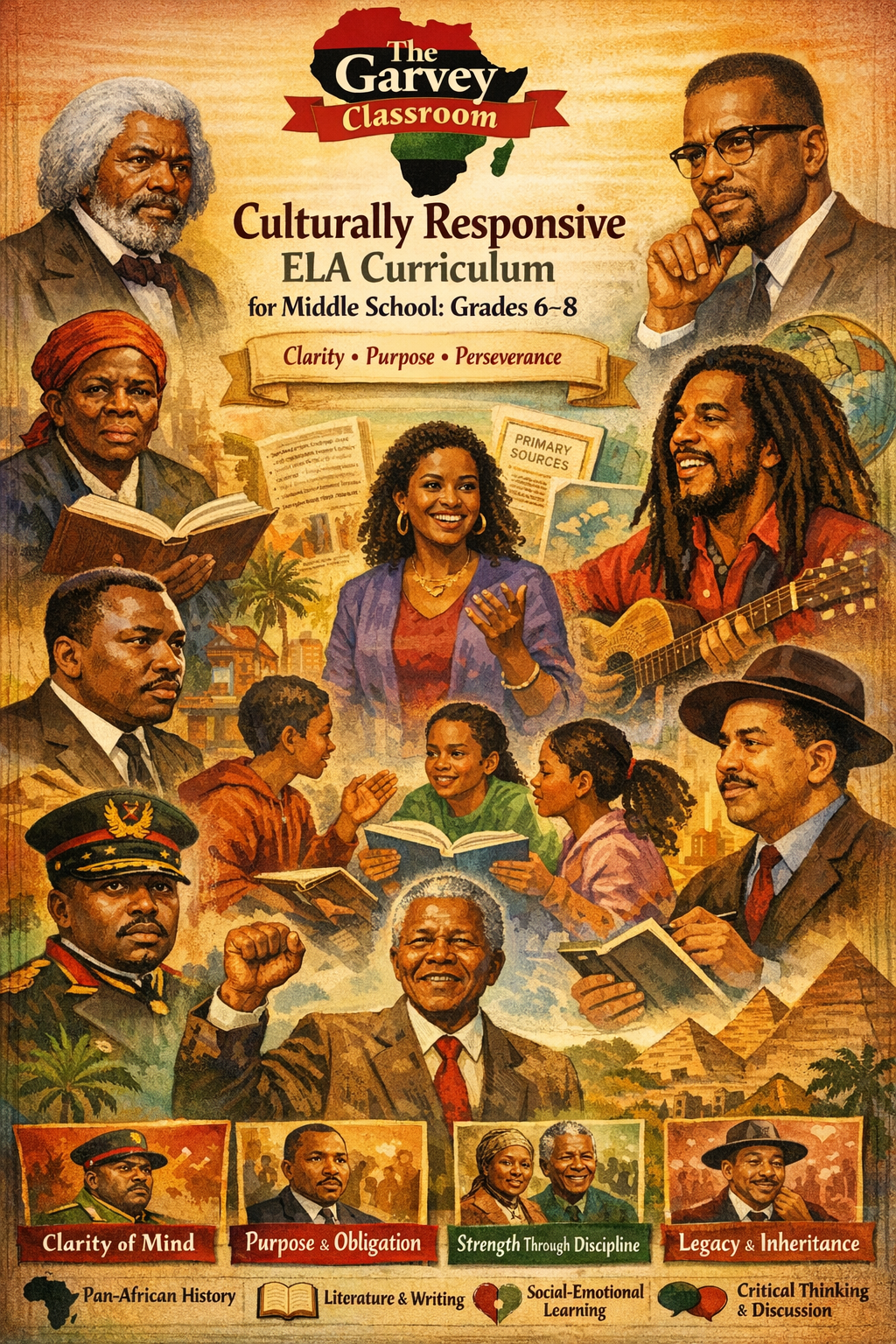
The Garvey Classroom offers a complete, standards-aligned, culturally responsive English Language Arts curriculum for grades 6 through 8. Built on the Garvey Blueprint framework of clarity, purpose, and perseverance, the curriculum integrates reading, writing, speaking, and listening instruction with embedded social-emotional learning and Pan-African historical content across a full 39-week academic year. The curriculum aligns to Common Core State Standards (CCSS), CASEL SEL competencies, the New York State Culturally Responsive-Sustaining Education Framework, UK Key Stage 3 requirements, and Caribbean national standards. It was created by Geoffrey Philp, a published Garvey scholar with 27 years of college teaching and six years as a middle school English teacher, and is endorsed by Dr. Julius W. Garvey and Professor Rupert Lewis of the University of the West Indies.
What Makes an ELA Curriculum Culturally Responsive?
A culturally responsive ELA curriculum does three things that standard programs do not. It centers student identity and voice as the entry point for literacy instruction. It integrates the histories, intellectual traditions, and lived experiences of the students it serves into every unit. And it connects reading and writing skills to questions of agency, belonging, and purpose rather than treating literacy as a neutral technical exercise.
The Garvey Classroom curriculum meets all three criteria through a story-driven instructional model. Students encounter historical figures as thinkers and strategists whose decisions can be analyzed, debated, and applied. Reading comprehension, argumentative writing, text-based evidence, and academic discussion develop through engagement with primary sources, biographical narratives, and essential questions that connect history to identity. This approach aligns with the research of Geneva Gay on culturally responsive teaching, Gloria Ladson-Billings on culturally relevant pedagogy, and Zaretta Hammond on cognitive science and culturally responsive instruction.
How Is This Curriculum Structured?
The curriculum operates across a 39-week academic year organized into four thematic quarters. Each quarter is anchored by a principle from the Garvey Blueprint framework and features 27 to 30 Pan-African and African diasporic historical figures studied through integrated ELA and SEL instruction.
Quarter 1: Clarity of Mind (September through November). Anchor figures include Marcus Garvey, Arturo Schomburg, and Frederick Douglass. Students develop foundational reading and writing skills while exploring self-knowledge, intellectual freedom, and the relationship between literacy and personal identity.
Quarter 2: Purpose and Obligation (December through February). Anchor figures include Malcolm X, Martin Luther King Jr., and Ella Baker. Students practice argumentative and analytical writing while examining how individual clarity translates into collective action and sustained purpose.
Quarter 3: Strength Through Discipline (March through April). Anchor figures include Nelson Mandela, Harriet Tubman, and Kwame Nkrumah. Students build research and synthesis skills while studying endurance, strategic planning, and liberation movements across the African diaspora.
Quarter 4: Legacy and Inheritance (May through June). Anchor figures include Langston Hughes, Bob Marley, and Wangari Maathai. Students complete portfolio writing and reflective assessments while examining how cultural production, environmental stewardship, and artistic expression carry forward the work of previous generations.
Each week follows a five-day instructional rhythm: Day 1 introduces the figure and essential question through story, Days 2 and 3 develop reading comprehension and text analysis, Day 4 focuses on writing and reflection, and Day 5 provides discussion, assessment, and community building. The rhythm is consistent across all 39 weeks, reducing teacher planning burden while maintaining instructional coherence.
What Standards Does This Curriculum Align To?
Every lesson is aligned to Common Core State Standards for ELA, covering Reading Informational Text (RI), Reading Literature (RL), Writing (W), and Speaking and Listening (SL) strands for grades 6 through 8. The curriculum also aligns with CASEL’s five core SEL competencies: self-awareness, self-management, social awareness, relationship skills, and responsible decision-making. SEL is embedded in academic practice rather than taught as a separate program.
For schools operating under New York State requirements, the curriculum aligns with the NYS Next Generation ELA Learning Standards and the NYC DOE Culturally Responsive-Sustaining Education Framework. A compiled Standards Alignment Appendix documents strand-level mappings for district review and accreditation purposes. Custom alignment documents are produced for every adopting school, including schools in jurisdictions outside New York.
International alignment includes UK Key Stage 3 requirements and Caribbean national curriculum frameworks. This cross-jurisdictional documentation makes the curriculum adoptable across North America, the United Kingdom, the Caribbean, and African nations implementing English-medium instruction.
How Does This Curriculum Integrate Social-Emotional Learning?
SEL in The Garvey Classroom is not a standalone program added alongside ELA instruction. It is embedded in the academic work itself. When students read about Frederick Douglass’s decision to teach himself to read, they practice self-awareness. When they analyze Ella Baker’s organizing strategy, they develop social awareness and relationship skills. When they write reflective essays connecting historical decisions to their own lives, they exercise responsible decision-making.
This approach aligns with research demonstrating that SEL integrated with academic instruction produces stronger outcomes than SEL taught in isolation (Durlak et al., 2011). Students are never asked to disclose personal experiences. Reflection and discussion are structured, optional, and grounded in academic content. The curriculum maintains clear boundaries between instruction and therapy, consistent with guidelines from the National Association of School Psychologists.
What Does Adoption and Implementation Look Like?
Adoption follows a six-phase pathway designed to ensure every school begins instruction with full preparation, proper standards alignment, and trained teachers.
Phase 1: Inquiry (2 to 4 weeks). The principal or curriculum director contacts The Garvey Classroom LLC to discuss school context, student demographics, standards requirements, and goals. A sample lesson plan, product overview, and consultation are provided at no cost.
Phase 2: Alignment (4 to 6 weeks). The Garvey Classroom LLC maps the curriculum to the school’s local standards framework and academic calendar. This phase produces the standards alignment document, calendar placement plan, and a customized licensing proposal.
Phase 3: Training (1 to 2 weeks pre-launch). Teachers receive orientation to the Garvey Blueprint philosophy, the five-day instructional rhythm, scaffolding and differentiation architecture, and the assessment system. No specialized background in African or Caribbean history is required. All training materials are provided.
Phase 4: Launch (Week 1 of instruction). The curriculum begins with Week 1: Gathering the Circle. Students and teachers establish the classroom community, create the classroom covenant, and begin the first writing assignment. Remote support is provided during launch.
Phase 5: Fidelity and Support (ongoing, Year 1). The Garvey Classroom LLC monitors implementation through observation checklists, lesson plan reviews, and periodic check-ins with school leadership. Teachers receive coaching on pacing, differentiation, and instructional challenges. Data collection protocols begin for ESSA evidence tier advancement.
Phase 6: Review and Renewal (end of Year 1). The school and The Garvey Classroom LLC review student growth data, teacher feedback, and implementation quality. The review determines whether to continue, expand to additional grade levels, or adjust implementation for Year 2.
What Research and Evidence Base Supports This Curriculum?
The instructional model draws on established research across four domains. Culturally responsive pedagogy (Geneva Gay, 2010; Gloria Ladson-Billings, 1995) provides the theoretical foundation for centering student identity in literacy instruction. Story-driven instruction and cognitive science research (Zaretta Hammond, 2015) informs the narrative-first approach to reading comprehension and engagement. Grit and perseverance research (Angela Duckworth, 2016) grounds the Garvey Blueprint framework’s emphasis on sustained effort and discipline. Formative assessment research (Black and Wiliam, 1998; Hattie, 2009) shapes the feedback and revision practices embedded in the five-day instructional rhythm.
Data collection protocols are built into implementation for ESSA evidence tier advancement. Schools participating in Year 1 implementation contribute to the growing evidence base. The curriculum’s research and evidence base references are documented in a separate annotated bibliography available for district review and grant applications.
How Is This Different from Other Culturally Responsive ELA Programs?
Most culturally responsive ELA programs take one of two approaches. Either they layer diverse texts onto a conventional skills-based framework, or they provide an equity lens and rubric that schools must apply to their existing curriculum. The Garvey Classroom is neither. It is a complete, year-long curriculum built from the ground up around culturally responsive principles. The cultural content is not supplemental. It is the curriculum.
The curriculum draws from a Pan-African intellectual tradition that most commercial programs do not access. Students study figures from Jamaica, South Africa, Ghana, Kenya, Trinidad, Burkina Faso, Mozambique, and the United States across the full academic year. Lessons reference scholarship from Robert Hill, Rupert Lewis, Tony Martin, Carter G. Woodson, John Henrik Clarke, C.L.R. James, Walter Rodney, and Frantz Fanon. This depth of scholarly grounding is unmatched in the K through 12 marketplace.
Three design features distinguish this work. First, every lesson uses verified quotes and primary sources. Second, historical figures are treated as strategists and system-builders whose methods are transferable, rather than inspirational symbols to admire from a distance. Third, the curriculum serves students of African descent specifically. It is a Pan-African solution designed for Pan-African students, addressing the systematic separation of African, Caribbean, and African American intellectual history from mainstream education.
How Does the Curriculum Support Diverse Learners?
The curriculum provides scaffolding and differentiation at every level. English Language Learners and multilingual learners access the same rigorous content through sentence frames, visual supports, extended time, strategic partnering, and bilingual glossaries. Students may use home languages during brainstorming, discussion, and drafting. Differentiation occurs through access supports rather than simplified content.
Students with IEPs receive accommodations built into the lesson architecture. The five-day instructional rhythm provides multiple entry points and modalities: oral storytelling, close reading, collaborative discussion, independent writing, and portfolio reflection. Students demonstrate mastery through oral responses, visual representations, dramatic interpretation, and collaborative work alongside written products.
Who Created This Curriculum?
Geoffrey Philp is a Jamaican-born author, poet, and educator. He taught middle school English for six years and spent 27 years as a professor and department chair at Miami Dade College. His published works include My Name Is Marcus, The Power of the Mind, Purpose, and Perseverance: A Marcus Garvey Reader, and Unstoppable You: Fifty Quotes from Marcus Garvey to Inspire Greatness. He is a Silver Musgrave Medal recipient and winner of the 2022 Marcus Garvey Award for Excellence in Education.
Geoffrey gathered more than 11,000 signatures in support of Marcus Garvey’s posthumous pardon and personally delivered them to Julius Garvey and U.S. Congresswoman Frederica Wilson. President Biden granted the pardon in January 2025.
Endorsements
“This course faithfully carries forward my father’s vision. It engages participants in the process to know themselves, define their purpose, and persevere in the face of obstacles and injustice.”
— Julius W. Garvey, M.D., O.J., Founder and Chairman, Marcus Garvey Institute for Human Development
“I endorse this initiative by Geoffrey Philp because the teaching of the philosophy of Marcus Garvey, which guided the movement for decolonization and civil rights, is imperative for our economic, social, and cultural goals in the 21st century.”
— Rupert Lewis, Professor Emeritus of Political Thought, University of the West Indies, Mona
How Do Schools and Districts Get Started?
School and district partnerships: Contact The Garvey Classroom LLC at info@thegarveyclassroom.com to begin the inquiry process. The initial consultation, product overview, and sample lesson plan are provided at no cost.
Individual teachers: Lesson plans and heritage month bundles are available for immediate download at The Garvey Classroom on Teachers Pay Teachers. A free Marcus Garvey Growth Mindset lesson is available as a starting point.
The Garvey Blueprint for Liberation Course: A 12-week structured learning experience for educators and adult learners, grounded in Garvey’s African School of Philosophy. Enrollment is open at Thinkific.
Full curriculum details: See the complete guide to Marcus Garvey lesson plans for teachers, grades 6 through 8.
Frequently Asked Questions
Does this curriculum replace our existing ELA program?
The Garvey Classroom curriculum is a complete ELA program for grades 6 through 8. It can serve as the primary ELA curriculum or as a supplementary enrichment program, depending on school needs and district requirements. Schools adopting the full curriculum receive a scope and sequence that satisfies all ELA standards for the grade band.
Can we adopt for one grade level first?
Yes. Many schools begin with Grade 6 and expand to Grades 7 and 8 in subsequent years. The curriculum is designed for vertical alignment, so adding grade levels follows the established framework without redundancy.
What if our standards framework differs from New York State?
The Garvey Classroom LLC produces a custom standards alignment document for every adopting school. The curriculum’s reading, writing, speaking, and listening demands map to standards frameworks across North America and the Caribbean. Custom mappings are produced for every jurisdiction.
What training do teachers need?
Teachers receive a one-to-two-week orientation before instruction begins. The training covers the Garvey Blueprint philosophy, the five-day instructional rhythm, scaffolding and differentiation, and assessment practices. No specialized background in African or Caribbean history is required. All materials and training are provided by The Garvey Classroom LLC.
Is this curriculum ESSA compliant?
The curriculum aligns with federal requirements under the Every Student Succeeds Act, including evidence-based instruction, equity, and whole-child development. Data collection protocols are built into implementation for ESSA evidence tier advancement. Schools participating in Year 1 contribute to the evidence base.
How is the curriculum delivered?
All materials are delivered digitally as formatted documents. Schools print student-facing materials locally. A consultation tool allows principals and teachers to generate differentiated lesson plans, parent communications, and progress reports as needed.
What does licensing cost?
Licensing is structured by school size and support level. Contact The Garvey Classroom LLC at info@thegarveyclassroom.com for a proposal tailored to your school’s needs. Licensing includes all materials, training, and Year 1 support.